Crypto Market Crash February 2026:
Why Bitcoin Dropped Below $75K and Survival Strategies
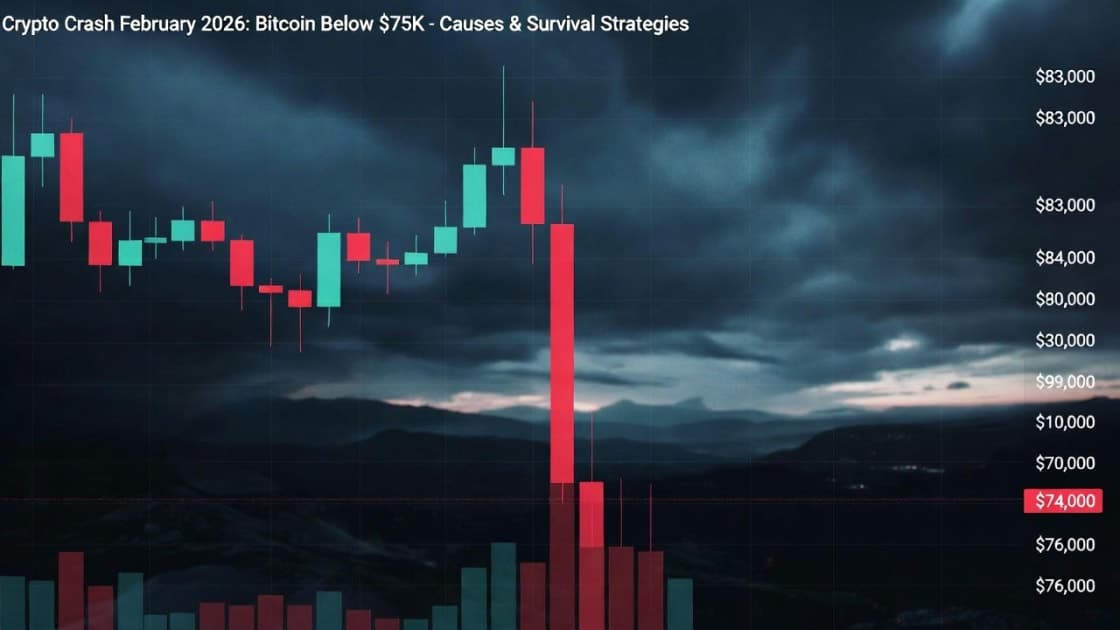
The cryptocurrency market entered February 2026 under intense selling pressure, delivering one of the sharpest drawdowns since the 2025 bull-market peak. Bitcoin (BTC) briefly plunged to $74,541 over the weekend—its lowest level since April 2025—before staging a modest rebound to the $76,000–$79,000 range by February 2.
The broader crypto market was hit even harder. Total market capitalization fell to approximately $2.65 trillion, with 91 of the top 100 cryptocurrencies posting losses. Forced liquidations exceeded $2.5 billion in the latest wave alone, underscoring the scale of leverage embedded across the ecosystem.
From its 2025 all-time high above $126,000, Bitcoin is now down roughly 35–40%, erasing a significant portion of unrealized gains and pushing market sentiment firmly into “extreme fear” territory.
What Triggered the February 2026 Crypto Sell-Off?
The sell-off was not driven by a single catalyst, but rather by a convergence of macroeconomic, structural, and market-specific factors.
1. Macroeconomic Pressure and Hawkish Signals
- Hotter-than-expected Producer Price Index (PPI) data reignited inflation concerns.
- The nomination of Kevin Warsh as a potential U.S. Federal Reserve Chair signaled a more hawkish monetary stance.
- Risk assets broadly sold off as markets priced in the possibility of higher-for-longer interest rates.
This macro backdrop reduced appetite for speculative assets, with crypto among the hardest hit.
2. ETF Outflows Accelerate
- U.S. spot Bitcoin ETFs recorded approximately $509.7 million in net outflows.
- Ethereum ETFs saw an additional $252.87 million leave the market.
- Many ETF investors who entered near 2025 highs are now underwater, contributing to continued redemptions.
ETF flows, once a tailwind, have temporarily turned into a headwind for price action.
3. Leverage Flush and Forced Liquidations
- More than $2 billion in leveraged positions—both long and short—were liquidated within days.
- High leverage magnified volatility, creating a cascading effect as margin calls triggered further selling.
- Derivatives markets, rather than spot selling alone, played a major role in accelerating the decline.
4. Broader Market Rotation
- Traditional equities, particularly large-cap technology stocks, outperformed crypto during the same period.
- Capital rotated into traditional safe havens, with gold and silver attracting inflows instead of digital assets.
- This shift challenged the short-term “digital gold” narrative for Bitcoin.
5. MicroStrategy and Sentiment Pressure
- MicroStrategy (MSTR) briefly traded below its average Bitcoin purchase price (~$76,052).
- Headlines around this level added psychological pressure to the market.
- While fundamentally unchanged, the optics contributed to short-term bearish sentiment.
Is the Market Near a Bottom?
Despite the severity of the correction, several analysts—including Tom Lee—suggest the market may be approaching a cyclical bottom rather than entering a prolonged bear market.
Supporting factors include:
- Continued on-chain activity growth, particularly on Ethereum
- Rising adoption of staking, tokenized assets, and Layer 2 solutions
- Long-term capital continuing to accumulate during periods of fear
While timing remains uncertain, fundamentals across major networks have not materially deteriorated.
Survival & Positioning Strategies for Volatile Times
In periods of extreme volatility, discipline and capital preservation become paramount. Below are strategies being actively employed by professional traders and long-term investors.
1. Risk Management Comes First
- Reduce or eliminate leverage, especially in uncertain macro conditions.
- Favor spot-only exposure over derivatives.
- Maintain 50–70% of portfolio value in stablecoins (USDT, USDC) to preserve dry powder and reduce drawdowns.
2. Dollar-Cost Averaging (DCA) Into Strength
- Implement fixed, scheduled purchases of BTC and ETH rather than attempting to time the bottom.
- Many market participants view the $70,000–$75,000 range as a potential medium-term support zone.
- DCA helps mitigate emotional decision-making during volatile markets.
3. Focus on Resilient Narratives
Selective exposure matters more than broad-market bets.
Altcoins showing relative strength include:
- Hyperliquid (HYPE): Recently outperformed with strong gains driven by sustained DEX and derivatives demand.
- DASH and Optimism (OP): Consolidating ahead of potential protocol upgrades and ecosystem growth.
Avoid:
- Highly leveraged tokens
- Illiquid meme-driven assets
- Projects with unsustainable token emissions
4. Hedging and Yield Generation
- Deploy idle capital into stablecoin lending or staking on established platforms such as Aave or Compound, offering approximately 4–8% APY.
- Some sophisticated traders are exploring prediction markets (e.g., Polymarket, Kalshi) to hedge macroeconomic or political outcomes.
- These strategies can generate yield while waiting for clearer market direction.
5. Patience and Historical Perspective
- Previous crypto cycles show that deep corrections often precede strong recoveries.
- Panic selling during fear-driven drawdowns has historically been one of the most costly mistakes.
- Long-term investors benefit from maintaining conviction while managing downside risk.
Conclusion
The February 2026 crypto market crash serves as a reminder that volatility remains a defining characteristic of digital assets. While the drop below $75,000 for Bitcoin has shaken confidence, it has not invalidated the broader structural case for crypto adoption.
This environment separates short-term speculation from long-term strategy. For disciplined participants, corrections are not merely periods of risk—but potential opportunities to reposition for the next phase of the cycle.
Staying liquid, selective, and patient may prove far more valuable than attempting to predict short-term price movements in an uncertain macro landscape.
Important DisclaimerLegal
All content on Bitiblocky is for educational and informational purposes only and does not constitute financial advice. Always do your own research (DYOR) and consult with a qualified financial advisor before making investment decisions. Cryptocurrency investments carry significant risk, and you should never invest more than you can afford to lose.
Frequently Asked Questions
A mix of ETF outflows, macro hawkishness, massive liquidations, and risk-off sentiment across markets triggered the sell-off.
Sign in to comment
Join the conversation by signing in