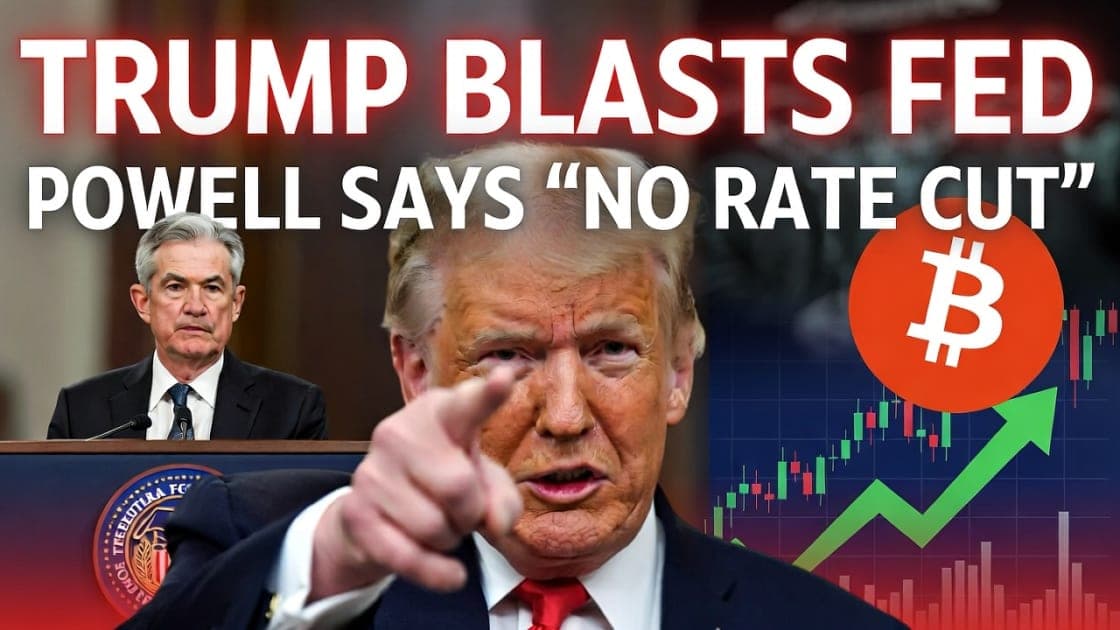
Trump Blasts Fed's Powell: "Too Late" on Rates — Tariffs Demand World's Lowest Borrowing Costs Now
President Donald Trump unleashed a fiery critique of Federal Reserve Chair Jerome Powell following the FOMC's January 28, 2026 decision to hold the federal funds rate steady at 3.5%–3.75%. In a lengthy post on X (formerly Twitter), Trump dubbed Powell "Jerome 'Too Late' Powell" and a "moron," accusing him of unnecessarily high rates that are "hurting our Country, and its National Security."
Trump argued that with inflation no longer a major threat (a point he claims even Powell admits), the Fed should slash rates substantially now. He tied this directly to his tariff policies, claiming they generate billions in revenue inflows, making America "strong and powerful again" — far stronger than any other nation — and justifying the lowest interest rates in the world.
"Because of the vast amounts of money flowing into our Country because of Tariffs, we should be paying the LOWEST INTEREST RATE OF ANY COUNTRY IN THE WORLD!"
— President Donald J. Trump
Trump further claimed high rates cost America "Hundreds of Billions of Dollars a year in totally unnecessary and uncalled for INTEREST EXPENSE," while portraying other countries as benefiting from low rates thanks to U.S. tolerance — a dynamic he says tariffs are correcting.
Fed's January 2026 Decision: Pause After Three Cuts
The FOMC voted 10-2 to maintain the target range, marking the first hold since July 2025 after three consecutive 25-basis-point reductions in late 2025. Chair Powell described the economy as expanding at a solid pace, with a stabilizing job market but "somewhat elevated" inflation. Two governors dissented in favor of a cut, but the majority emphasized caution amid tariff-related uncertainties and one-time price pressures expected to fade.
This pause breaks momentum in the easing cycle, contributing to cautious sentiment across financial markets.
Why This Matters for Crypto, Blockchain, and AI Markets
Lower interest rates typically act as rocket fuel for risk-on assets:
- Reduced borrowing costs encourage speculative investment in volatile sectors like cryptocurrencies and blockchain innovation.
- Weaker USD (often following rate cuts) supports dollar-denominated assets like Bitcoin and altcoins.
- Higher liquidity flows into emerging tech, including AI tokens, DeFi protocols, and Web3 projects that rely on cheap capital for growth.
The current hold has kept markets on edge, with traders pricing in perhaps only one or two modest cuts for the remainder of 2026. Trump's aggressive rhetoric adds layers of policy uncertainty — pressuring the Fed's independence while highlighting potential shifts if a more dovish successor replaces Powell (term ends May 2026).
Tariffs introduce mixed effects: short-term inflationary risks (which Powell noted) could delay cuts, but Trump views them as a strength multiplier enabling ultra-low rates. For crypto investors, this standoff creates volatility — but also opportunity if political pressure eventually forces easier policy.
As macro conditions evolve in 2026, crypto and blockchain participants should watch Fed dot plots, tariff implementation details, and any signals on Powell's successor closely. Liquidity remains king in digital asset cycles.
What do you think — will Trump's pressure accelerate rate cuts, or will the Fed stay data-dependent? Drop your thoughts in the comments!
Sources: Federal Reserve FOMC statement (Jan 28, 2026), President Trump's X post (Jan 29, 2026), market analysis from Reuters, CNBC, and Trading Economics.
Important DisclaimerLegal
All content on Bitiblocky is for educational and informational purposes only and does not constitute financial advice. Always do your own research (DYOR) and consult with a qualified financial advisor before making investment decisions. Cryptocurrency investments carry significant risk, and you should never invest more than you can afford to lose.
Frequently Asked Questions
Citing solid economic growth, stabilizing jobs, and lingering inflation pressures (partly from tariffs), the FOMC voted 10-2 to maintain the 3.5%-3.75% range.
Sign in to comment
Join the conversation by signing in