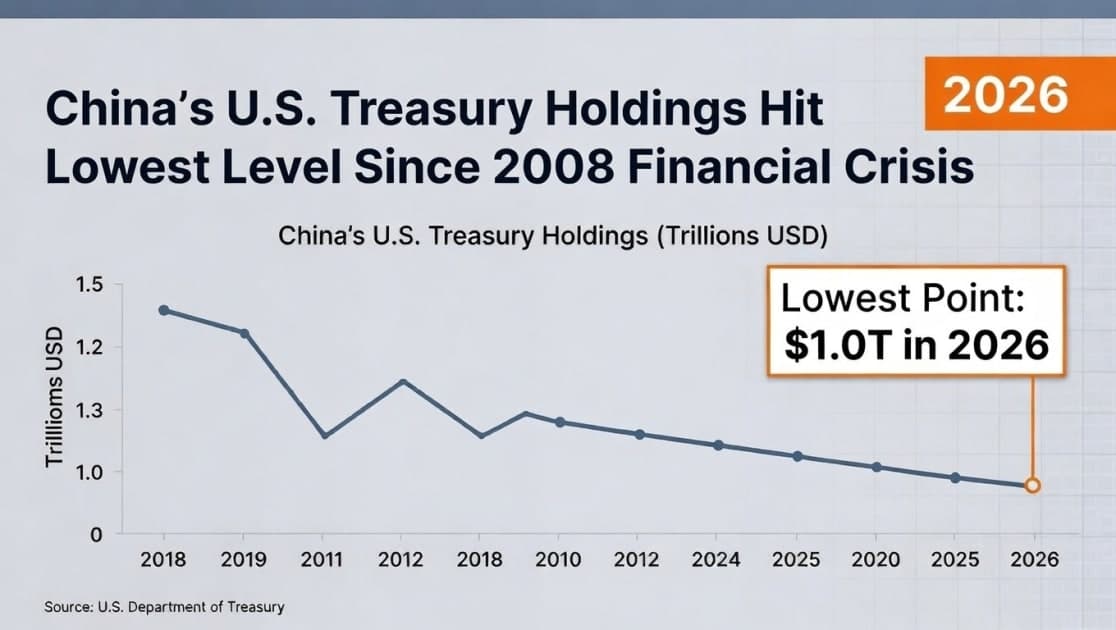
China’s U.S. Treasury Holdings Hit Post-2008 Low
According to the most recent Treasury International Capital (TIC) data released in early 2026, China’s holdings of U.S. Treasury securities have fallen to approximately $768 billion — the lowest level recorded since the depths of the 2008 global financial crisis.
This continues a multi-year trend: China has steadily reduced its exposure to U.S. government debt from a peak of over $1.3 trillion in 2013. The latest drop of roughly $50–60 billion in recent quarters has accelerated the decline and drawn renewed attention from economists, central bankers, and cryptocurrency analysts.
Why Is China Selling U.S. Treasuries?
Several factors are driving this strategic shift:
- Geopolitical diversification — Ongoing U.S.–China tensions, trade friction, and concerns over potential financial sanctions have pushed Beijing to reduce reliance on dollar-denominated assets.
- Currency and reserve management — China has been increasing allocations to gold (now the second-largest official reserve asset after the dollar) and exploring digital currencies (digital yuan / e-CNY) as part of a broader de-dollarization strategy.
- Yield and portfolio rebalancing — With U.S. interest rates remaining elevated, some sales may reflect tactical profit-taking or reallocation to higher-yielding or less politically sensitive assets.
- Support for the yuan — Selling Treasuries provides dollars that can be used to stabilize or support the renminbi during periods of capital outflow pressure.
While Japan remains the largest foreign holder of U.S. Treasuries (≈ $1.15 trillion), China’s reduction is symbolically and strategically significant.
Implications for the U.S. Dollar and Global Finance
The decline in Chinese demand for Treasuries has not yet triggered a dramatic spike in U.S. borrowing costs — domestic buyers, other foreign central banks, and private investors have absorbed the supply. However, the long-term trend raises important questions:
- Erosion of dollar dominance — A major holder steadily exiting could gradually weaken the dollar’s role as the world’s primary reserve currency.
- Higher long-term yields — Reduced foreign official demand may eventually push U.S. Treasury yields higher, increasing borrowing costs for the U.S. government.
- Acceleration of alternative assets — Central banks (including China, Russia, India, and others) have sharply increased gold purchases and shown growing interest in cryptocurrencies as non-sovereign, censorship-resistant stores of value.
The Crypto & Bitcoin Angle
This trend is closely watched in the cryptocurrency community for several reasons:
- Bitcoin as “digital gold” — As central banks diversify away from U.S. debt, Bitcoin’s fixed supply and independence from any single government make it an increasingly attractive hedge.
- De-dollarization momentum — Countries reducing dollar exposure often increase allocations to gold and crypto simultaneously. Recent moves by BRICS nations suggest a gradual shift toward multi-polar reserve systems.
- Potential U.S. policy response — If foreign official demand for Treasuries continues to weaken, U.S. policymakers may adopt a more crypto-friendly stance to attract capital flows, already visible in discussions around Bitcoin strategic reserves and stablecoin regulation.
Looking Forward
While China’s Treasury sales are not new, reaching the lowest level since 2008 underscores the durability of the trend. It is less a sudden crisis trigger and more a structural realignment of global reserve management.
For crypto participants, the message is clear: geopolitical and macroeconomic shifts that weaken traditional dollar hegemony tend to strengthen the long-term case for decentralized, borderless assets like Bitcoin and Ethereum.
Whether this marks the start of a faster de-dollarization phase or simply another step in a decade-long process, 2026 is shaping up to be a pivotal year for understanding how nations are repositioning their reserves — and where capital may flow next.
Important DisclaimerLegal
All content on Bitiblocky is for educational and informational purposes only and does not constitute financial advice. Always do your own research (DYOR) and consult with a qualified financial advisor before making investment decisions. Cryptocurrency investments carry significant risk, and you should never invest more than you can afford to lose.
Frequently Asked Questions
According to the latest TIC data (early 2026), China holds approximately $768 billion in U.S. Treasury securities — the lowest since 2008.
Sign in to comment
Join the conversation by signing in