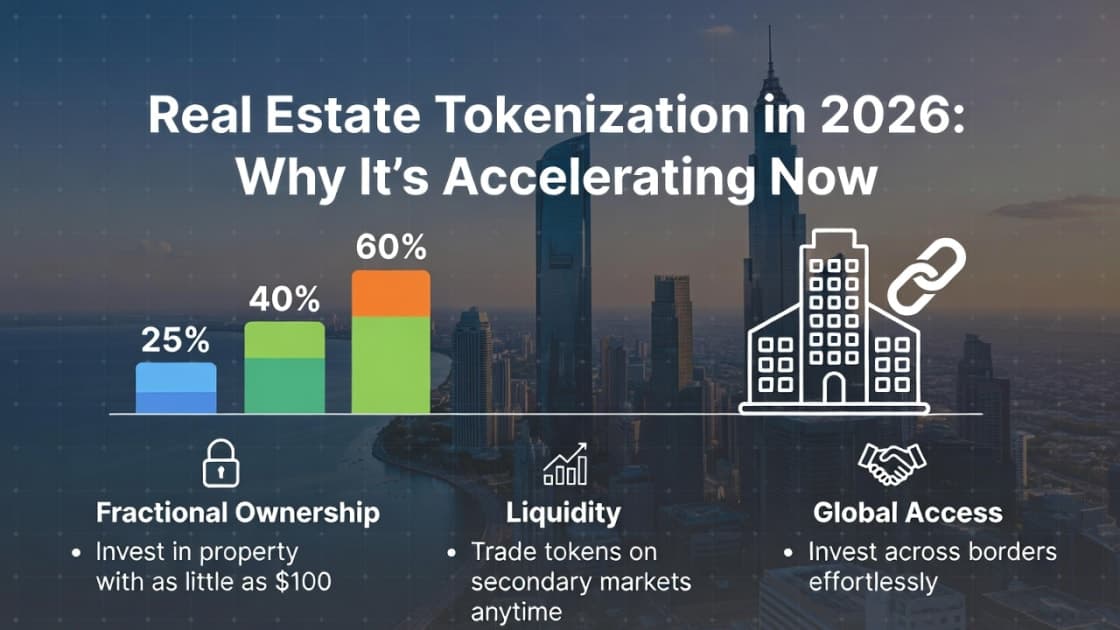
Real Estate Tokenization in 2026: Why It’s Accelerating Now
Real-world asset (RWA) tokenization has emerged as one of the most transformative trends in 2026, with real estate at the center of this shift. By converting physical properties into blockchain-based digital tokens, platforms are unlocking fractional ownership, faster settlement, and global investor access—fundamentally reshaping how property is owned, financed, and traded.
What was once a niche experiment has now become a serious focus for institutions, asset managers, and developers, driven by technological maturity and clear economic incentives.
What Is Real Estate Tokenization?
Real estate tokenization involves representing ownership rights or cash flows from a property as on-chain tokens. These tokens can represent:
- Fractional equity ownership
- Revenue-sharing claims (rents, yields)
- Debt instruments backed by property
- Development-stage exposure to land and projects
Tokens can be traded, used as collateral, or integrated into decentralized finance (DeFi) protocols, while remaining legally tied to the underlying asset.
Why 2026 Is a Turning Point
Several converging forces are accelerating adoption in 2026:
1. Institutional Demand for Liquidity
Traditional real estate is:
- Illiquid
- Capital-intensive
- Slow to transact
Tokenization introduces:
- Faster settlement cycles
- Partial exits without selling entire properties
- Programmable compliance and reporting
Institutions now see tokenized real estate as a liquidity upgrade rather than a speculative novelty.
2. Blockchain Infrastructure Has Matured
Improvements across blockchain ecosystems enable real estate tokenization at scale:
- Lower transaction costs on Layer 2 networks
- Enhanced data availability and security
- Smart contract-based governance and distributions
- Interoperability with DeFi protocols
This infrastructure reduces friction that previously limited adoption.
3. Macro Conditions Favor Alternative Assets
In a world of:
- Elevated interest rates
- Inflation uncertainty
- Tighter credit conditions
Investors are increasingly attracted to yield-generating real assets. Tokenized real estate offers exposure to property income streams with greater flexibility and accessibility.
Market Size and Growth Outlook
Industry projections suggest:
- Billions of dollars in tokenized real estate by the mid-to-late 2020s
- Strong participation from private equity, REIT-style vehicles, and sovereign funds
- Growth across residential, commercial, industrial, and mixed-use properties
Early adoption is already visible in:
- Tokenized real estate funds
- On-chain property-backed lending
- Blockchain-based property syndications
Key Benefits of Tokenized Real Estate
Fractional Ownership
- Investors can gain exposure with significantly lower capital
- Portfolio diversification across geographies and property types
- Access for global investors previously excluded from certain markets
Faster and More Efficient Transactions
- Near-instant settlement compared to weeks or months
- Reduced intermediaries and administrative costs
- Automated compliance and record-keeping
Transparency and Trust
- Immutable on-chain records
- Real-time visibility into ownership and cash flows
- Reduced risk of fraud or data manipulation
Integration With DeFi
Tokenized real estate is increasingly used within DeFi ecosystems:
- Property-backed tokens used as collateral for loans
- Yield-bearing tokens integrated into DeFi vaults
- On-chain refinancing and liquidity provision
This convergence creates a bridge between traditional assets and decentralized finance.
Use Cases Gaining Traction in 2026
- Tokenized real estate funds offering diversified exposure
- Property-backed stable yields for conservative investors
- Development-stage land tokenization for early-stage capital
- Real estate-backed credit markets on-chain
- Cross-border property investment without local intermediaries
These applications highlight the flexibility of programmable ownership.
Challenges and Risks
Despite rapid growth, several hurdles remain:
Regulatory Uncertainty
- Varying legal frameworks across jurisdictions
- Securities classification and compliance requirements
- Custody and investor protection standards
Progress is being made, but clarity remains uneven globally.
Valuation and Data Accuracy
- Reliable, real-time property valuation is complex
- Dependence on off-chain data providers (oracles)
- Market liquidity still developing for secondary trading
Market Education and Trust
- Investors must understand both real estate and blockchain risks
- Traditional players remain cautious about custody and smart contract exposure
The Road Ahead
As regulation matures and infrastructure improves, real estate tokenization is expected to move from early adoption to mainstream financial tooling. In the long term, tokenized property could become:
- A standard component of investment portfolios
- A liquidity layer for global real estate markets
- A foundational asset class within DeFi and hybrid finance systems
Conclusion
Real estate tokenization in 2026 represents more than incremental innovation—it marks a structural shift in how property markets operate. By lowering barriers, increasing transparency, and enabling global participation, tokenization is positioning real estate as a digitally native asset class for the next generation of investors.
While challenges remain, the momentum behind tokenized real estate suggests that on-chain property ownership is no longer a question of if, but how fast.
Important DisclaimerLegal
All content on Bitiblocky is for educational and informational purposes only and does not constitute financial advice. Always do your own research (DYOR) and consult with a qualified financial advisor before making investment decisions. Cryptocurrency investments carry significant risk, and you should never invest more than you can afford to lose.
Frequently Asked Questions
Converting property into blockchain tokens for fractional, liquid ownership.
Sign in to comment
Join the conversation by signing in