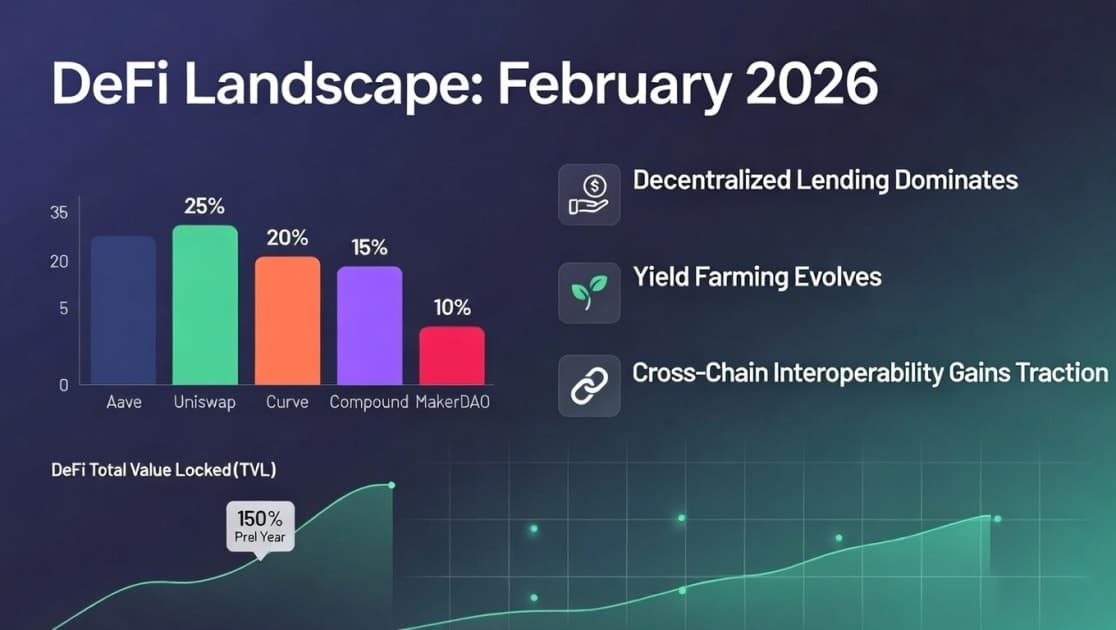
DeFi in February 2026: Top Protocols and Trends Driving Growth
Decentralized Finance (DeFi) continues to mature and expand in early February 2026, even as broader crypto markets experience periods of volatility. While token prices have fluctuated, usage, revenues, and real economic activity across DeFi protocols remain resilient, signaling that the sector has moved beyond purely speculative growth into a more sustainable phase.
At the center of this evolution are revenue-generating platforms, deeper integration of real-world assets (RWAs), and a renewed focus on real yield and capital efficiency.
Market Overview: A Resilient DeFi Sector
- Total Value Locked (TVL): Holding relatively steady despite market drawdowns
- User Activity: Consistent or rising across major lending and trading platforms
- Revenue Models: Increasing emphasis on protocol fees rather than token emissions
DeFi in 2026 is increasingly judged not by hype cycles, but by cash flow, stickiness, and utility.
Leading Protocols by Activity and Revenue
Hyperliquid (HYPE)
Hyperliquid has emerged as one of the most talked-about DeFi platforms in 2026.
Key strengths:
- High-volume perpetuals and spot trading
- Tokenized gold and silver markets, offering on-chain exposure to commodities
- Deep liquidity with minimal slippage
- Strong fee generation and user retention
Hyperliquid’s success reflects growing demand for non-crypto-native assets within DeFi ecosystems.
Aave
Aave remains a cornerstone of decentralized lending.
Notable trends:
- Strong borrowing demand from both retail and institutional users
- Growing adoption of stablecoin-based yield strategies
- Increased integration with RWAs and tokenized treasuries
- Improved risk management frameworks
Aave’s longevity underscores the value of battle-tested protocols during uncertain market conditions.
Jupiter and Aerodrome
DEX infrastructure continues to thrive, particularly on high-performance chains.
- Jupiter dominates aggregation and routing efficiency, capturing significant swap volume
- Aerodrome benefits from ecosystem incentives and strong liquidity depth
These platforms highlight the importance of efficient liquidity discovery in multi-chain DeFi.
Key Trends Shaping DeFi in 2026
1. Real Yield Over Emissions
Projects are increasingly:
- Reducing token inflation
- Distributing protocol fees to stakers
- Prioritizing sustainable revenue models
This shift has attracted longer-term capital and reduced mercenary liquidity.
2. Tokenized Real-World Assets (RWAs)
RWAs have become a major growth driver:
- Tokenized treasuries, commodities, and credit products
- On-chain access to off-chain yield
- Growing institutional participation
DeFi is evolving into a bridge between traditional finance and on-chain infrastructure.
3. Cross-Chain Liquidity and Interoperability
Newer projects are focused on:
- Seamless cross-chain swaps
- Unified liquidity pools
- Abstracting away bridge complexity for users
This trend reduces fragmentation and improves capital efficiency across ecosystems.
4. Improved UX and Institutional Readiness
DeFi platforms are investing heavily in:
- Cleaner interfaces
- Smart account integration
- Compliance-friendly tooling
- Risk dashboards and analytics
User-friendly design is now seen as a competitive advantage, not an afterthought.
Emerging Protocols and High-Potential Categories
Several areas are drawing increased attention from investors and users alike:
- Next-generation lending protocols offering isolated risk markets
- DEX aggregators optimized for speed and MEV resistance
- Yield optimization platforms focused on capital efficiency
- Synthetic asset platforms expanding beyond crypto-only exposure
While still early-stage, these projects offer asymmetric upside for participants willing to take on higher risk.
DeFi’s Role in the Broader Crypto Ecosystem
By February 2026, DeFi is no longer viewed as a niche experiment. Instead, it functions as:
- A core liquidity layer for crypto markets
- An alternative financial system for global users
- A testing ground for financial innovation
- A gateway for institutions exploring on-chain finance
Even during market downturns, DeFi’s continued growth in volume, revenue, and utility reinforces its long-term relevance.
Conclusion
DeFi in February 2026 reflects a sector that has learned from past cycles. The focus has shifted decisively toward real yield, robust infrastructure, and practical use cases. With leading protocols like Hyperliquid, Aave, and Jupiter setting the pace—and emerging projects pushing innovation forward—DeFi appears well-positioned for its next phase of expansion as mark
Important DisclaimerLegal
All content on Bitiblocky is for educational and informational purposes only and does not constitute financial advice. Always do your own research (DYOR) and consult with a qualified financial advisor before making investment decisions. Cryptocurrency investments carry significant risk, and you should never invest more than you can afford to lose.
Frequently Asked Questions
Hyperliquid, Aave, Jupiter, and others with high revenue and volumes.
Sign in to comment
Join the conversation by signing in