Tokenization of Real-World Assets on Blockchain: Why RWAs Are Exploding in April 2026
Published: April 28, 2026
Category: Blockchain News
Introduction
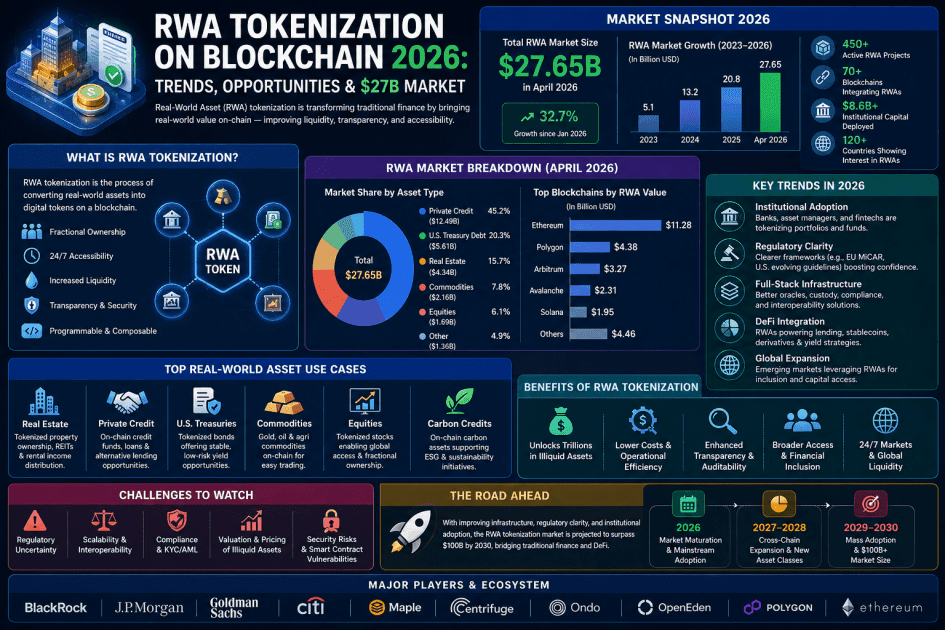
Despite broader crypto market volatility, the Real World Assets (RWA) sector continues its steady climb. In April 2026, the tokenized RWA market surpassed $27.65 billion, marking a 4.07% increase amid challenging market conditions.<grok-card data-id="24dc9b" data-type="citation_card" data-plain-type="render_inline_citation" ></grok-card>
Tokenization is revolutionizing traditional finance by bringing illiquid assets — such as real estate, government bonds, fine art, commodities, and private credit — onto the blockchain. This process enables fractional ownership, greater transparency, instant settlement, and 24/7 global trading.
In this comprehensive guide, we explore what blockchain tokenization means, the key drivers fueling RWA growth in April 2026, major benefits, challenges, leading platforms, and the future outlook for this transformative technology.
What Is Blockchain Tokenization?
Blockchain tokenization is the process of converting rights to an asset into a digital token on a distributed ledger. Each token represents ownership or a share of the underlying real-world asset.
How Tokenization Works
The process typically involves these key components:
- Smart Contracts: Self-executing code that automates ownership transfer, dividend distribution, and compliance rules.
- Token Standards: Common standards include ERC-1400, ERC-3643 (for compliant securities), and others tailored for security tokens.
- Oracles: Services that feed real-world data (asset valuation, interest rates, ownership verification) onto the blockchain reliably.
- Compliance Layers: Integrated KYC (Know Your Customer), AML (Anti-Money Laundering), and investor accreditation checks to meet regulatory requirements.
Once tokenized, assets can be traded peer-to-peer on decentralized exchanges or through regulated platforms, significantly reducing intermediaries like brokers and custodians.
Tokenization bridges Traditional Finance (TradFi) and Decentralized Finance (DeFi), unlocking trillions in currently illiquid value.
Key Drivers in April 2026
Several powerful forces are accelerating RWA adoption this month:
- Institutional Adoption and Regulatory Progress: Major institutions like BlackRock continue expanding tokenized funds (e.g., BUIDL). Regulatory clarity in key jurisdictions is improving, reducing uncertainty for issuers and investors.
- Integration with Stablecoins and DeFi: Stablecoins act as the "internet’s dollar," enabling seamless yield generation and liquidity within DeFi protocols. Tokenized assets can now be used as collateral for borrowing and lending.
- Solana and Other Chains Breaking Records: Solana has shown explosive growth in tokenized RWAs, surpassing Ethereum in the number of RWA-holding wallets earlier this year and crossing the $2 billion mark in total RWA value on the network by March 2026. Its high speed and low fees make it attractive for high-frequency and retail-oriented RWA activity. Ethereum remains the dominant settlement layer with institutional trust.
- Convergence with AI for Automated Valuation and Compliance: Artificial intelligence is being integrated to automate asset valuation, risk assessment, compliance monitoring, and even autonomous investment decisions using tokenized assets.
These drivers have helped the sector grow from roughly $8–9 billion a year ago to nearly $30 billion on-chain in 2026, demonstrating strong resilience.
Benefits of RWA Tokenization
Tokenization offers transformative advantages over traditional asset management:
- Liquidity for Illiquid Assets: Real estate and private credit, which traditionally take months to sell, can now be traded 24/7 in fractional units.
- Fractional Ownership Democratizing Access: Investors can buy as little as $10–$100 worth of premium real estate or fine art, opening high-value markets to retail participants.
- Transparency and Immutability: All transactions and ownership records are visible on the public blockchain, reducing fraud and increasing trust.
- Global Accessibility and Reduced Intermediaries: Anyone with an internet connection and compatible wallet can participate, cutting costs associated with banks, lawyers, and custodians.
- Yield Opportunities: Tokenized Treasuries and private credit products offer attractive, stable yields directly in investors' wallets, often outperforming traditional savings in a low-interest environment.
These benefits explain why RWAs are attracting both institutional capital and retail investors seeking real utility beyond speculative crypto trading.
Challenges and Regulatory Landscape
While promising, RWA tokenization faces several hurdles:
- Legal Hurdles for Certain Asset Classes: Real estate laws, securities regulations, and cross-border rules vary significantly by jurisdiction.
- Custody and Bridging Risks: Secure off-chain custody of underlying assets and safe bridging between blockchains remain critical concerns.
- Interoperability Between Chains: Moving tokenized assets seamlessly across Ethereum, Solana, Polygon, and others requires robust cross-chain solutions.
- Oracle Reliability and Data Accuracy: Dependence on oracles for real-world data introduces potential points of failure or manipulation.
Regulatory progress is mixed. Some regions are creating sandboxes for tokenization experiments, while others maintain strict rules. The industry expects clearer frameworks (such as potential U.S. market structure bills) to further accelerate growth in the coming months.
Leading Projects and Platforms in 2026
Several platforms and projects are leading the RWA revolution:
- Ondo Finance: A dominant player in tokenized U.S. Treasuries and yield-bearing products (OUSG, USDY). It bridges institutional-grade assets with DeFi accessibility.
- BlackRock’s BUIDL Fund: One of the largest tokenized money market funds, now available on multiple blockchains via Securitize.
- RealT: Specializes in fractional ownership of U.S. residential and commercial real estate, distributing rental income weekly in stablecoins.
- Centrifuge: Focuses on private credit and invoice financing, bringing real business cash flows on-chain.
- Other Notable Players: Brickken (full lifecycle tokenization infrastructure), Securitize, Tokeny, Maple Finance, and Matrixdock.
Popular Asset Classes include:
- Tokenized U.S. Treasuries (largest category, often exceeding $10–12 billion)
- Private credit
- Real estate
- Commodities (especially gold)
- Tokenized equities and funds
Ethereum holds the majority of institutional RWA value, while Solana leads in growth rate and retail participation.
Future Outlook and Predictions
The future of RWAs looks exceptionally bright. Analysts project the tokenized asset market could reach $10–30 trillion by 2030, with some optimistic forecasts going even higher. Real estate is expected to become one of the largest tokenized categories.
RWAs have the potential to truly bridge TradFi and DeFi by bringing trillions in traditional assets on-chain. Deeper integration with AI agents could enable autonomous portfolio management, where AI handles valuation, rebalancing, and compliance using tokenized assets.
By 2030, we may see standardized on-chain financial products, widespread institutional adoption, and tokenized assets becoming a normal part of global portfolios. The combination of blockchain transparency, DeFi composability, and real-world yields creates a powerful flywheel for growth.
How Investors Can Participate
Investors have multiple ways to gain exposure to the RWA sector:
- Direct Token Purchases: Buy tokenized Treasuries (e.g., via Ondo or BlackRock BUIDL) or fractional real estate tokens on platforms like RealT.
- RWA-Focused Funds and Protocols: Participate in DeFi pools that use RWAs as collateral for higher yields.
- Governance and Utility Tokens: Invest in tokens of leading RWA platforms (e.g., ONDO) for exposure to ecosystem growth.
- Yield-Generating Strategies: Stake or lend tokenized assets in compliant DeFi protocols to earn additional returns.
Tip: Always conduct thorough due diligence, understand the regulatory status in your jurisdiction, and start with smaller allocations while the sector matures.
Conclusion
Tokenization represents one of the most practical and impactful use cases of blockchain technology in 2026, moving far beyond speculation toward real economic utility.
As the tokenized RWA market continues its upward trajectory — reaching over $27.65 billion in April 2026 — it is reshaping how the world owns, trades, and monetizes assets. Whether you are an institutional investor seeking efficiency or a retail participant looking for new opportunities, RWAs offer a compelling glimpse into the future of finance.
The convergence of blockchain, stablecoins, AI, and traditional assets is just beginning. Those who understand and participate early stand to benefit significantly as this sector scales toward trillions in the coming years.
This post is for educational and informational purposes only and does not constitute financial advice.
Important DisclaimerLegal
All content on Bitiblocky is for educational and informational purposes only and does not constitute financial advice. Always do your own research (DYOR) and consult with a qualified financial advisor before making investment decisions. Cryptocurrency investments carry significant risk, and you should never invest more than you can afford to lose.
Frequently Asked Questions
RWA stands for Real World Assets — tangible or traditional financial assets tokenized on the blockchain.
Sign in to comment
Join the conversation by signing in