The Rise of Agentic AI in 2026
How Autonomous Agents Are Reshaping Industries and Daily Life
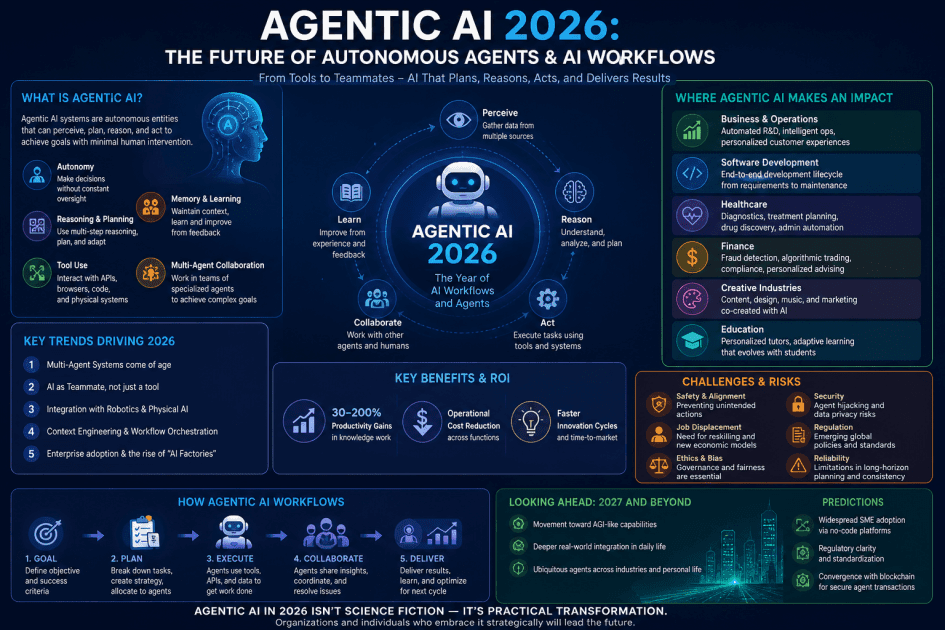
In 2026, artificial intelligence is evolving beyond chatbots and copilots into agentic systems—autonomous entities that can plan, reason, act, and collaborate with minimal human intervention. This shift marks a pivotal moment where AI becomes a true partner rather than just a tool.
What Is Agentic AI and Why Does It Matter Now?
Agentic AI refers to AI systems capable of goal-oriented behavior. They break down complex tasks, use tools, iterate on plans, and interact with other agents or external environments.
Key Characteristics
- Autonomy: Making decisions without constant oversight
- Reasoning and Planning: Using chain-of-thought, tree-of-thoughts, or multi-step reasoning
- Tool Use: Integrating with APIs, browsers, code interpreters, and physical actuators
- Memory and Learning: Maintaining context across sessions and adapting from feedback
- Multi-Agent Collaboration: Teams of specialized agents working together
2026 marks the "Year of AI Workflows and Agents" as models become commoditized and focus shifts to orchestration and real-world deployment.
Historical Context and Evolution
- Rule-based systems (pre-2022)
- Large Language Models (2022–2023)
- Multimodal & reasoning models (2024–2025)
- Agentic frameworks maturity (2026)
Emerging Frameworks
- Auto-GPT successors
- LangGraph
- CrewAI
- Enterprise platforms from OpenAI, Anthropic, Google, Microsoft
Key Trends Driving Agentic AI in 2026
1. Multi-Agent Systems (MAS) Come of Age
Multiple specialized agents collaborate:
- Researcher → gathers data
- Analyst → interprets insights
- Writer → drafts content
- Editor → refines output
Use cases:
- Customer support
- Software development
- Supply chain optimization
2. AI as Teammate, Not Tool
AI is evolving into a collaborative partner that enhances:
- Productivity
- Research
- Creativity
3. Integration with Robotics and Physical AI
- Humanoid robots trained on large datasets
- AI controlling real-world systems
Applications:
- Manufacturing
- Healthcare
- Elder care
4. Context Engineering Over Prompt Engineering
- Shift from prompts → structured workflows
- Memory layers + orchestration
- Rise of:
- Intent-driven development
- “Vibe coding”
5. Enterprise Adoption and "AI Factories"
Organizations are building:
- Dedicated AI infrastructure
- High-scale processing systems
- Custom agent ecosystems
Industry-Specific Impacts
Business & Productivity
- Automated R&D pipelines
- Adaptive intelligent operations
- Personalized customer experiences
Software Development
- Full lifecycle automation:
- Requirements → Code → Deployment → Maintenance
- “AI is eating software”
Healthcare
- Diagnostic agents
- Personalized treatment
- Drug discovery acceleration
- Admin automation
Finance
- Fraud detection
- Algorithmic trading
- Compliance monitoring
- Personalized financial advising
Creative Industries
- AI-assisted content creation
- Music, art, and marketing collaboration
- Human oversight for quality
Education
- Personalized tutors
- Adaptive learning systems
- Continuous improvement tracking
Technical Deep Dive: How Agentic Systems Work
Architectures
- ReAct (Reason + Act)
- Plan-and-Execute
- Multi-Agent Debate
Frameworks
- LangChain / LangGraph
- AutoGen
- Semantic Kernel
Challenges
- Hallucinations
- Tool failures
- Coordination overhead
- Safety risks
Solutions
- Human-in-the-loop systems
- Verification layers
- Sandboxing
- Formal methods
Benefits and ROI
- 30–200% productivity gains
- Operational cost reduction
- Faster innovation cycles
Case Studies (Illustrative)
- Customer support → 60% fewer tickets
- Software teams → faster delivery
- Enterprises → better decision-making
Challenges and Risks
Safety & Alignment
- Preventing unintended actions
Job Displacement
- Need for reskilling
- Concepts like “minimum wage for robots”
Ethics & Bias
- Governance frameworks required
Security
- Agent hijacking
- Data privacy risks
Regulation
- Emerging global policies
Reliability
- Limitations in long-term planning
Future Outlook: 2027 and Beyond
- Movement toward AGI-like capabilities
- Deeper real-world integration
- Ubiquitous AI agents
Predictions
- SME adoption via no-code platforms
- Regulatory clarity
- Blockchain integration for secure agent transactions
Conclusion
Agentic AI in 2026 is no longer science fiction—it’s a practical transformation.
Businesses and individuals who adopt it strategically will gain a significant advantage in the next technological era.
Important DisclaimerLegal
All content on Bitiblocky is for educational and informational purposes only and does not constitute financial advice. Always do your own research (DYOR) and consult with a qualified financial advisor before making investment decisions. Cryptocurrency investments carry significant risk, and you should never invest more than you can afford to lose.
Frequently Asked Questions
Agentic AI goes beyond simple responses by autonomously planning, reasoning, and executing tasks. Unlike traditional AI tools that require constant human input, agentic systems can handle complex workflows end-to-end, significantly boosting productivity and efficiency.
Sign in to comment
Join the conversation by signing in