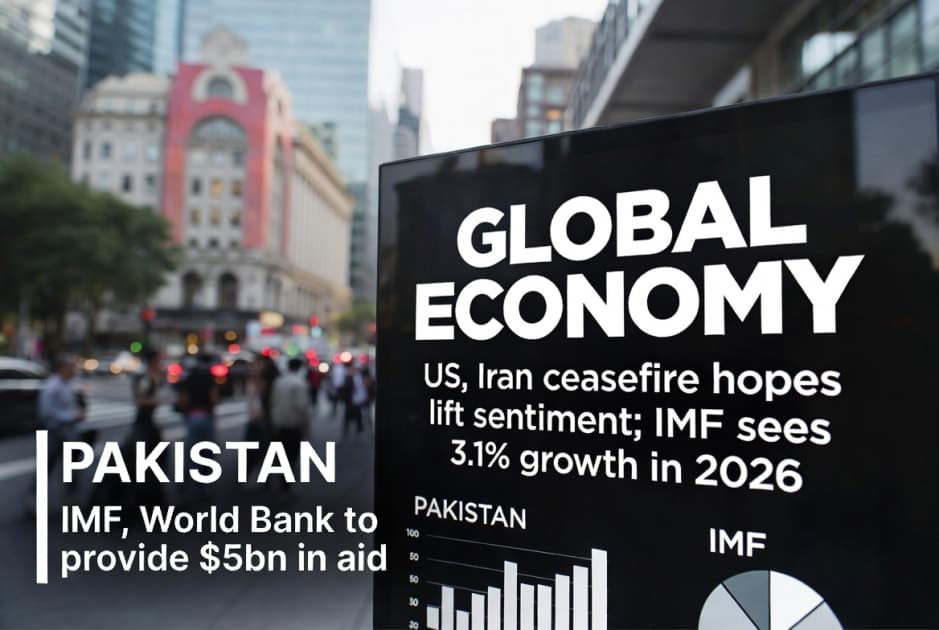
Global Economy News Today: Iran Ceasefire Talks, IMF Downgrades Growth to 3.1%, Pakistan Gets $5Bn Aid – April 2026 Update
As of April 16, 2026, the global economy stands at a critical juncture. Optimism surrounding ongoing US-Iran ceasefire talks has fueled a relief rally in financial markets, with the S&P 500 and Nasdaq hitting fresh record highs. At the same time, the International Monetary Fund (IMF) has downgraded its global growth forecast to 3.1% for 2026 due to the lingering effects of the Middle East conflict. In South Asia, cash-strapped Pakistan has secured a much-needed $5 billion financial aid package from Saudi Arabia and Qatar.
This global economy news update examines the latest developments, their interconnected impacts, and what they mean for investors, businesses, and emerging markets like Pakistan.
US-Iran Ceasefire Talks: A Fragile Ray of Hope
The two-week ceasefire between the United States and Iran, which entered its second week in mid-April 2026, has brought cautious optimism to global markets. Diplomatic efforts, including discussions in Islamabad, are exploring a potential extension or even a longer-term agreement to resolve the conflict that began in late February.
Investors are increasingly pricing in de-escalation. On April 15, the S&P 500 closed at a new all-time high of 7,022.95 (up 0.80%), while the tech-heavy Nasdaq Composite surged to 24,016.02 (up 1.59%). The Dow Jones Industrial Average ended slightly lower at 48,463.72 (-0.15%), but overall sentiment remained positive as markets looked past near-term risks.
This rally reflects a classic "risk-on" shift: reduced geopolitical uncertainty lowers energy price volatility and supports corporate earnings and consumer spending. However, the ceasefire remains fragile, and any breakdown could quickly reverse these gains.
Oil Prices Today: Easing but Still Elevated
Oil prices have moderated amid ceasefire hopes but remain significantly higher than pre-conflict levels. On April 16, 2026:
- Brent Crude is hovering around $94–96 per barrel.
- WTI Crude trades near $91–92 per barrel.
The partial reopening of shipping lanes and reduced fears of prolonged disruption through the Strait of Hormuz have eased supply concerns. Still, prices are elevated due to lingering disruptions, which continue to influence global inflation and growth prospects.
For import-dependent economies, this moderation in oil prices provides some relief on import bills and helps contain inflationary pressures. Energy exporters, however, face mixed outcomes depending on the duration of the conflict.
IMF World Economic Outlook April 2026: Growth Downgraded
The IMF released its latest World Economic Outlook on April 14, 2026, highlighting how the Iran conflict has "halted" pre-war economic momentum. Under the reference (baseline) scenario — assuming a short-lived, limited conflict — global growth is now projected at 3.1% in 2026 and 3.2% in 2027. This represents a downgrade from pre-conflict expectations of around 3.4%.
Global headline inflation is expected to rise modestly to 4.4% in 2026 before declining again.
The IMF outlined three key scenarios:
- Reference Scenario (Limited Conflict): Growth at 3.1%. Oil prices moderate in the second half of 2026. Most economies experience a manageable slowdown.
- Adverse Scenario: Growth falls to 2.5% with inflation rising to 5.4%. This assumes a sharper and more prolonged energy price spike plus tighter financial conditions.
- Severe Scenario: Growth drops to 2% (recession territory) with inflation exceeding 6%. This envisions extended supply disruptions, unanchored inflation expectations, and significant market dislocations.
The report emphasizes that risks are "decisively tilted to the downside." Emerging market and developing economies — especially net energy importers with limited policy buffers — face the heaviest impact. Advanced economies are not immune, with higher energy costs eroding consumer purchasing power and corporate margins.
The IMF chief economist noted that before the war, the global economy was poised for an upgrade thanks to AI-driven productivity gains and easing trade tensions. The conflict has reversed that momentum.
Impact of the Iran War on the Global Economy
The 2026 Iran conflict has triggered the largest oil supply disruption in history, according to energy analysts. Disruptions in the Strait of Hormuz — a critical chokepoint for nearly 20% of global oil trade — have led to higher energy and food prices worldwide.
Key effects include:
- Inflationary Pressure: Higher oil costs feed into transportation, manufacturing, and consumer goods.
- Slower Growth: Reduced consumer spending and business investment in affected sectors.
- Currency Volatility: Emerging markets face pressure from a stronger US dollar and capital outflows.
- Sectoral Shifts: Technology and AI stocks benefit from risk-on sentiment, while energy, airlines, and import-heavy industries face headwinds.
Even in the best-case scenario, the war has already caused measurable damage. Prolonged conflict could push the global economy toward stagflation — a toxic mix of slow growth and high inflation.
Pakistan Economy News: $5 Billion Aid from Saudi Arabia and Qatar
In a timely boost for Pakistan, Saudi Arabia and Qatar have pledged $5 billion in financial assistance. This package aims to ease pressure on the country’s weak foreign exchange reserves and help meet upcoming debt obligations, including a significant repayment to the UAE.
Pakistan, as a major oil importer, has been particularly vulnerable to elevated energy prices. The aid provides short-term breathing room, helping stabilize the Pakistani rupee, support essential imports, and reduce immediate default risks.
Finance Ministry sources indicate the funds will support external payments due in the coming months. This development comes as Pakistan’s Finance Minister engages in broader economic diplomacy, including at the IMF-World Bank Spring Meetings.
For the local economy, lower oil prices combined with this inflow could help moderate inflation and support modest recovery in growth. However, structural challenges — including fiscal deficits, energy sector reforms, and export diversification — remain critical for long-term stability.
How Lower Oil Prices and Ceasefire Hopes Benefit Emerging Markets
Countries like Pakistan, India, and other net oil importers stand to gain from easing energy costs. Reduced import bills free up fiscal space for development spending and debt servicing.
Asian markets reacted positively on April 16, with indices showing resilience despite choppy trading. The Indian Sensex recovered points on lower oil expectations, while broader regional sentiment improved alongside Wall Street’s record closes.
For Pakistan specifically, the combination of Saudi-Qatar support and global de-escalation offers a window to strengthen reserves and implement necessary reforms. Failure to capitalize on this could leave the economy exposed if tensions reignite.
Key Economic Data and Risks to Watch
On April 16, 2026, markets are monitoring US releases including jobless claims, the Philadelphia Fed manufacturing survey, and industrial production figures. These will provide clues about underlying economic strength amid geopolitical noise.
Broader risks include:
- Breakdown in ceasefire talks leading to renewed oil spikes.
- Persistent inflation forcing central banks to maintain tighter policy.
- Geopolitical fragmentation affecting global trade and investment flows.
- Vulnerability in high-debt emerging markets.
Investors and policymakers must balance short-term relief with long-term structural resilience.
Investment and Business Implications in 2026
The current environment favors a selective approach:
- Bullish Factors: Ceasefire progress, record stock performance in tech/AI sectors, and potential policy support if inflation eases.
- Cautious Outlook: IMF’s downside risks, elevated (though moderating) oil prices, and headline-driven volatility.
Businesses should focus on supply chain diversification, cost management, and hedging against energy volatility. Investors may consider diversified portfolios with exposure to quality growth stocks, commodities, and defensive assets.
For emerging market investors, Pakistan’s aid package and regional stability improvements could create selective opportunities, but thorough due diligence is essential.
Conclusion: Cautious Optimism Amid Uncertainty
On April 16, 2026, global economy news reflects a delicate balance. US-Iran ceasefire talks have sparked market optimism and record highs on Wall Street, while the IMF’s 3.1% growth forecast serves as a sober reminder of the conflict’s lasting impact. Pakistan’s $5 billion aid from Saudi Arabia and Qatar provides vital short-term relief for one of the region’s vulnerable economies.
While de-escalation hopes offer a positive backdrop, the situation remains fluid. A successful extension of the ceasefire could tilt outcomes toward the IMF’s more benign scenario, supporting global recovery. Conversely, any escalation would amplify downside risks.
Businesses, investors, and policymakers should stay agile, monitor diplomatic developments closely, and prioritize resilience in this uncertain environment. The coming weeks will be decisive in shaping the global economic trajectory for the remainder of 2026 and beyond.
Stay informed with regular updates on oil prices, stock market movements, and emerging economy developments.
Important DisclaimerLegal
All content on Bitiblocky is for educational and informational purposes only and does not constitute financial advice. Always do your own research (DYOR) and consult with a qualified financial advisor before making investment decisions. Cryptocurrency investments carry significant risk, and you should never invest more than you can afford to lose.
Frequently Asked Questions
The two-week ceasefire is ongoing, with both sides considering a two-week extension to allow more time for peace negotiations.
Sign in to comment
Join the conversation by signing in