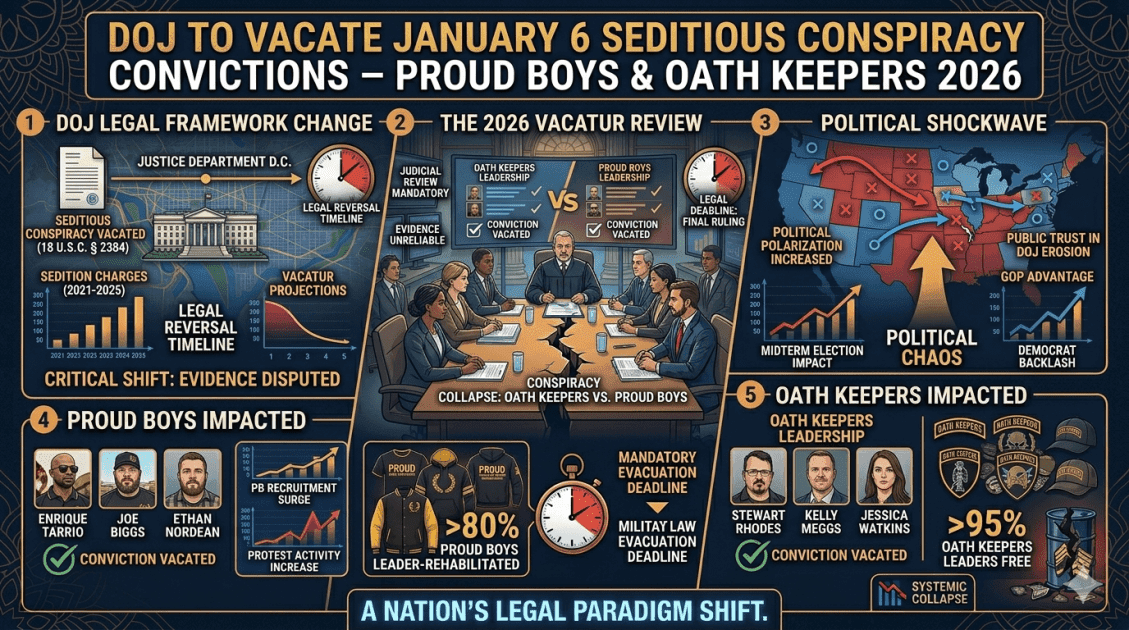
DOJ Seeks to Erase January 6 Seditious Conspiracy Convictions in Major 2026 Development
Last Updated: April 15, 2026
Introduction
In a major and highly consequential legal development, the United States Department of Justice (DOJ) has moved to vacate several high-profile seditious conspiracy convictions tied to the January 6, 2021 attack on the U.S. Capitol.
The filing, submitted on April 15, 2026, requests that the U.S. Court of Appeals for the District of Columbia Circuit dismiss these cases entirely and erase the convictions from official records. If approved, this move would represent one of the most significant reversals in the legal aftermath of January 6.
This development comes amid broader shifts in federal policy following President Donald Trump’s return to office and signals a dramatic change in how the DOJ is handling legacy cases connected to the Capitol riot.
What the DOJ Is Requesting
The DOJ is asking the federal appeals court to:
- Vacate (nullify) the convictions of specific January 6 defendants
- Dismiss the charges entirely
- Erase the convictions from legal records
This goes beyond previous legal actions, such as sentence reductions or commutations, and instead seeks to completely remove the legal findings of guilt.
Key Statement from the DOJ
“The government has decided in its prosecutorial discretion that dismissal of these criminal cases is in the interests of justice.”
This statement underscores the DOJ’s position that continuing to uphold these convictions is no longer aligned with its current interpretation of justice and legal priorities.
Who Is Affected?
The DOJ’s motion targets several high-profile individuals who were previously convicted of seditious conspiracy, one of the most serious charges brought in connection with January 6.
Notable Figures
- Stewart Rhodes – Founder of the Oath Keepers
- Ethan Nordean – Prominent Proud Boys leader
- Joseph Biggs – Senior figure within the Proud Boys
These individuals were convicted for their roles in organizing and leading efforts related to the events at the U.S. Capitol.
Understanding Seditious Conspiracy Charges
Seditious conspiracy is a rare and severe federal charge involving:
- Attempts to overthrow or oppose the government by force
- Efforts to prevent the execution of U.S. laws
- Organized planning of actions against government authority
The convictions related to January 6 were considered historic because such charges are rarely successfully prosecuted in modern U.S. history.
Background: January 6 and Legal Fallout
What Happened on January 6, 2021?
On January 6, 2021, supporters of then-President Donald Trump stormed the U.S. Capitol in an effort to disrupt the certification of the 2020 presidential election results.
The incident led to:
- Multiple deaths and injuries
- Significant property damage
- A large-scale federal investigation
масштаб of Prosecutions
- Hundreds of individuals were charged with various offenses
- Dozens faced serious felony charges
- A small group was charged with seditious conspiracy
These prosecutions were widely viewed as a cornerstone of accountability efforts following the attack.
What Changed in 2026?
The current DOJ filing cannot be understood without considering the political and legal shifts that occurred in 2026.
Trump’s Return to Office
After returning to the presidency, Donald Trump:
- Issued broad pardons and commutations for many January 6 defendants
- Reduced sentences for individuals convicted of serious crimes
- Left a small group with commuted (but not pardoned) sentences
The Remaining Defendants
Approximately a dozen individuals continued to pursue legal appeals because:
- Their sentences were reduced but not eliminated
- Their convictions remained on record
- The “seditious conspiracy” label still applied
Why This Filing Is Different
This new DOJ action goes significantly further than previous measures.
Key Differences
| Previous Actions | Current DOJ Filing |
|---|---|
| Sentence commutations | Full dismissal of charges |
| Convictions remain | Convictions erased |
| Legal guilt still recognized | Legal guilt removed |
If approved, this would:
- Remove the “sedition” designation entirely
- Clear criminal records of affected individuals
- Eliminate long-term legal consequences
Legal and Political Implications
This development has sparked intense debate among legal experts, policymakers, and the public.
1. End of High-Level January 6 Prosecutions
If the court grants the DOJ’s request:
- It could mark the final chapter in major seditious conspiracy cases
- Remaining high-profile prosecutions would effectively conclude
- The legal narrative around January 6 could shift significantly
2. Impact on Ongoing and Future Cases
The decision could influence:
- Other pending appeals related to January 6
- How federal prosecutors approach politically sensitive cases
- Future use of seditious conspiracy charges
Legal analysts suggest it may set a precedent for revisiting controversial convictions.
3. Debate Over Accountability vs. Overreach
The move has divided opinion across political and legal communities.
Critics Argue:
- It undermines accountability for the Capitol attack
- It weakens the rule of law
- It sends a concerning message about political influence on justice
Supporters Argue:
- It corrects what they view as prosecutorial overreach
- It restores fairness in politically charged cases
- It aligns with broader clemency efforts
The Role of the Appeals Court
The U.S. Court of Appeals for the District of Columbia Circuit will now decide whether to:
- Approve the DOJ’s request
- Reject the motion
- Request further legal arguments
What Happens Next?
- Legal briefs and responses may be submitted
- Judges will review the justification for dismissal
- A ruling could have nationwide legal implications
As of now, no final decision has been made.
Broader Context: A Shifting Legal Landscape
This development is part of a wider set of major national and global events shaping 2026.
Parallel Headlines Include:
- Rising geopolitical tensions such as the US-Iran blockade in the Strait of Hormuz
- Domestic political controversies and investigations
- Ongoing debates over executive power and judicial independence
Together, these events reflect a period of significant transition in both U.S. policy and global affairs.
What This Means Going Forward
The DOJ’s move signals a broader shift in how the federal government approaches:
- Politically sensitive prosecutions
- Use of rarely applied charges like seditious conspiracy
- The balance between justice, discretion, and policy
Key Questions Ahead
- Will the court approve the dismissal?
- How will this affect public trust in the legal system?
- Could similar cases be revisited in the future?
These questions will shape the legal and political landscape in the months ahead.
Conclusion
The DOJ’s request to erase seditious conspiracy convictions tied to January 6 marks a pivotal moment in the ongoing aftermath of one of the most significant events in recent U.S. history.
If approved, the move would not only clear the records of several high-profile defendants but also redefine how accountability, justice, and political influence intersect within the American legal system.
As the appeals court considers the request, the nation—and the world—will be watching closely.
Stay Updated
Follow this story for:
- Court rulings and legal updates
- Analysis from legal experts
- Broader political implications
Disclaimer
This article is for informational purposes only and does not constitute legal advice.
Important DisclaimerLegal
All content on Bitiblocky is for educational and informational purposes only and does not constitute financial advice. Always do your own research (DYOR) and consult with a qualified financial advisor before making investment decisions. Cryptocurrency investments carry significant risk, and you should never invest more than you can afford to lose.
Frequently Asked Questions
Market analysis includes technical analysis (charts, indicators), fundamental analysis (project value, team, adoption), and sentiment analysis. Our market analysis articles break down these concepts to help you make informed decisions.
Sign in to comment
Join the conversation by signing in