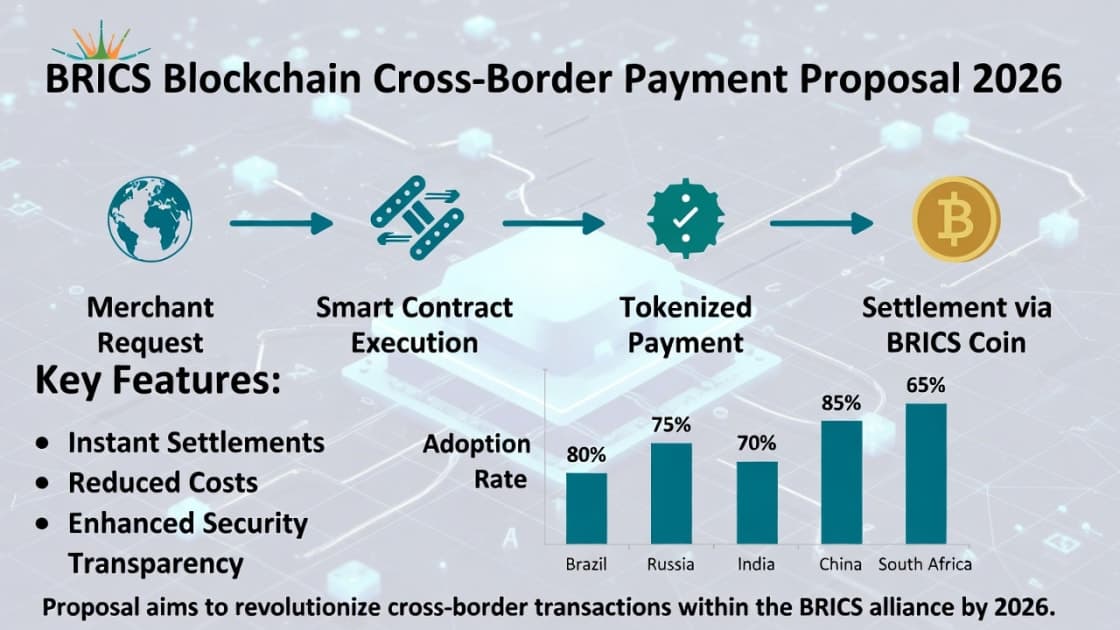
🌍 BRICS Proposes Blockchain-Based Cross-Border Payment Network
February 2026
BRICS nations have taken a meaningful step toward reshaping global payment infrastructure. Under India’s current BRICS chairmanship, the Reserve Bank of India (RBI) publicly outlined an initiative that could mark one of the most consequential real-world deployments of blockchain technology to date.
🧩 Today’s Development
- Reserve Bank of India unveiled a proposal for a
“BRICS Digital Currency Interconnection” - The system aims to link participating countries’ CBDCs (Central Bank Digital Currencies) and digital settlement layers
- Infrastructure would be built on a shared, permissioned blockchain network
- Core objective:
👉 Reduce reliance on USD-based correspondent banking systems and SWIFT
Rather than replacing national currencies, the proposal focuses on interoperability, allowing sovereign digital currencies to settle directly with one another.
🔎 What Is Being Proposed (Conceptually)
- A multi-ledger or shared settlement layer connecting:
- Digital yuan (e-CNY)
- Digital rupee
- Digital ruble
- Digital real (and others as they come online)
- Atomic settlement between central banks or approved financial institutions
- Optional integration of regulated stablecoins or tokenized commodities for trade settlement
- Governance controlled by BRICS monetary authorities, not a public network
This is not a retail crypto system—it is a state-level financial rail.
🌐 Why This Matters
Even partial implementation would represent one of the most geopolitically significant blockchain use cases ever attempted.
Potential Implications
- ⚡ Faster & cheaper cross-BRICS trade settlement
- 🛡️ Reduced exposure to USD sanctions and payment system exclusion
- 🏦 Increased legitimacy for CBDCs and compliant digital assets
- 🧱 Competitive pressure on SWIFT, CHIPS, and correspondent banking
- 📉 Lower FX friction for energy, commodities, and manufacturing trade
In effect, this would introduce a parallel global settlement network—not replacing the dollar overnight, but slowly eroding its monopoly in trade finance.
🏦 Strategic Context
- BRICS nations now account for ~35–40% of global trade growth
- Several members face sanctions risk or dollar liquidity constraints
- Trust in Western-controlled financial infrastructure has weakened since 2022–2024
- Blockchain offers neutral settlement logic without ceding control to another state
This initiative reflects financial multipolarity, not crypto idealism.
🧪 Current Status (Feb 2026)
- Still at the proposal / coordination stage
- No binding treaty or formal launch date announced
- Technical working groups reportedly active
- Multiple BRICS nations already:
- Running retail CBDC pilots
- Testing wholesale interbank settlement
- Parallel discussions ongoing around:
- Commodity-backed settlement tokens
- Energy and metals trade invoicing outside USD rails
Momentum exists—but political alignment remains the gating factor.
⏱️ Short-Term Watchpoints (2026)
Key questions to monitor:
- Will China, Russia, and India publicly align on a roadmap or pilot timeline?
- Will non-BRICS emerging markets (MENA, Africa, LATAM) seek observer or participant status?
- Will settlement initially focus on energy and commodities?
- How will the G7, IMF, and BIS respond—coordination or resistance?
- Will private-sector banks be allowed limited access, or excluded entirely?
🧠 Big Picture Takeaway
This initiative is unlikely to move crypto prices tomorrow—but it may shape the next decade of blockchain adoption.
If successful, it would:
- Validate blockchain as critical financial infrastructure
- Accelerate the shift toward regionalized payment systems
- Blur the line between crypto rails and sovereign money
In terms of long-term impact, this story matters far more than most short-term market volatility—and it’s only just getting started.
Important DisclaimerLegal
All content on Bitiblocky is for educational and informational purposes only and does not constitute financial advice. Always do your own research (DYOR) and consult with a qualified financial advisor before making investment decisions. Cryptocurrency investments carry significant risk, and you should never invest more than you can afford to lose.
Frequently Asked Questions
No. It’s a proposed interoperability layer between national digital currencies / settlement systems using blockchain technology.
Sign in to comment
Join the conversation by signing in