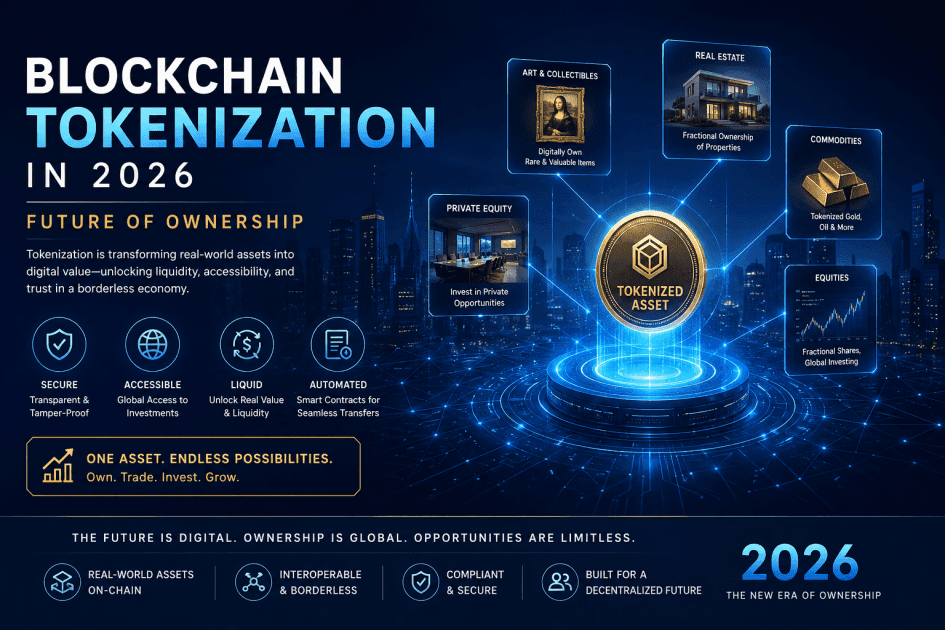
Blockchain in Real Life: How Tokenization is Changing Ownership in 2026
Blockchain technology has evolved far beyond cryptocurrencies. In 2026, one of its most powerful and disruptive applications is tokenization — the process of turning real-world assets into digital tokens on a blockchain.
This innovation is not just a technical upgrade; it is fundamentally reshaping how we define ownership, how we invest, and how global markets operate.
From real estate and art to financial assets and intellectual property, tokenization is unlocking new possibilities that were previously unimaginable.
The Evolution of Blockchain Beyond Crypto
When blockchain first emerged, it was primarily associated with cryptocurrencies like Bitcoin and Ethereum. However, over the years, the technology has matured into something far more impactful.
In 2026, blockchain is now being used in:
- Healthcare systems
- Supply chain tracking
- Digital identity verification
- Financial infrastructure
But among all these applications, tokenization stands out as one of the most transformative innovations.
It bridges the gap between physical and digital worlds, allowing real-world assets to exist and be traded digitally with transparency and security.
What is Tokenization?
Tokenization is the process of converting ownership rights of a real-world asset into a digital token stored on a blockchain.
Each token represents a share or unit of that asset, and ownership can be verified instantly through the blockchain ledger.
These assets include:
- Real estate 🏠
- Stocks 📈
- Art 🎨
- Gold 🪙
- Commodities
- Intellectual property
- Music rights
- Collectibles
Instead of needing large amounts of capital to buy entire assets, individuals can now purchase fractional ownership through tokens.
How Tokenization Works
To understand tokenization, imagine a high-value property worth $1 million.
Traditionally:
- Only wealthy individuals or institutions could buy it.
With tokenization:
- The property is divided into 1,000 tokens.
- Each token represents $1,000 worth of ownership.
- Anyone can buy one or more tokens.
These tokens are:
- Stored on a blockchain
- Easily transferable
- Fully traceable
- Secure from fraud
This creates a completely new model of ownership that is accessible, transparent, and efficient.
Why Tokenization Matters
Tokenization is gaining massive traction in 2026 because it solves some of the biggest problems in traditional finance and ownership systems.
1. Fractional Ownership
One of the biggest barriers in investing has always been high entry costs.
With tokenization:
- You don’t need millions to invest in real estate
- You can own shares of expensive assets
- Investment becomes more inclusive
This opens doors for small investors worldwide.
2. Global Access
Tokenization removes geographical barriers.
Anyone with an internet connection can:
- Invest in international markets
- Own assets in different countries
- Participate in global economies
This is especially powerful for developing countries where access to global investments has been limited.
3. Increased Liquidity
Traditional assets like real estate are illiquid — meaning they are hard to sell quickly.
Tokenization changes this by:
- Allowing instant buying and selling
- Enabling 24/7 markets
- Reducing dependency on intermediaries
This makes assets far more flexible and efficient.
4. Transparency and Security
Blockchain ensures:
- All transactions are recorded permanently
- Ownership is verifiable
- Fraud is minimized
This builds trust in systems where transparency was previously lacking.
Real-World Use Cases
Tokenization is not just theoretical — it is already being used across industries.
Real Estate
Real estate is one of the biggest beneficiaries of tokenization.
Traditionally:
- Buying property requires large capital
- Processes are slow and complex
With tokenization:
- Investors can buy fractional shares
- Properties can be traded globally
- Transactions are faster and cheaper
This is transforming real estate into a liquid, accessible asset class.
Digital Art & NFTs
Artists are leveraging tokenization to:
- Sell digital ownership
- Reach global audiences
- Earn royalties automatically
NFTs (Non-Fungible Tokens) are a form of tokenization that has revolutionized digital ownership.
Finance and Banking
Financial institutions are adopting blockchain to:
- Reduce transaction costs
- Enable faster settlements
- Improve cross-border payments
Tokenized assets can be traded instantly without traditional banking delays.
🪙 Commodities and Gold
Gold and commodities can now be tokenized, allowing:
- Secure digital ownership
- Easy trading without physical storage
- Global accessibility
This modernizes traditional investment assets.
Intellectual Property & Media
Creators can tokenize:
- Music rights
- Videos
- Patents
This allows them to:
- Monetize directly
- Maintain control over ownership
- Earn passive income
The Rise of RWA (Real World Assets)
One of the biggest trends in 2026 is RWA Tokenization (Real World Assets).
This refers to bringing physical assets onto the blockchain.
It allows:
- Secure ownership records
- Transparent transactions
- Reduced fraud
- Programmable assets
Major institutions are now entering this space, including:
- Investment firms
- Governments
- Tech companies
RWA tokenization is expected to become a multi-trillion-dollar market in the coming years.
Benefits for Businesses and Investors
For Businesses:
- Access to global funding
- Reduced operational costs
- Faster transactions
For Investors:
- Lower entry barriers
- Diversified portfolios
- Increased liquidity
This creates a win-win ecosystem.
Challenges to Consider
Despite its advantages, tokenization is not without challenges.
1. Regulatory Uncertainty
Different countries have different laws regarding:
- Digital assets
- Securities
- Ownership rights
This creates confusion and slows adoption.
2. Security Risks
Although blockchain is secure, risks still exist:
- Smart contract vulnerabilities
- Hacking attempts
- Poor platform security
Users must choose trusted platforms.
3. Adoption Barriers
Many people still:
- Don’t understand blockchain
- Lack technical knowledge
- Distrust digital systems
Education and awareness are key to mass adoption.
4. Market Volatility
Tokenized assets may experience price fluctuations, especially in early-stage markets.
Future Outlook
The future of tokenization looks extremely promising.
By 2030, experts predict:
- Most assets will be tokenized
- Global markets will operate 24/7
- Ownership will become fully digital
Imagine a World Where:
- You can buy property with one click
- You trade assets instantly across borders
- You own global investments from your smartphone
- Transactions happen without middlemen
This is not science fiction — it is the direction we are heading.
Tokenization and the Global Economy
Tokenization has the potential to:
- Democratize wealth
- Reduce inequality
- Increase financial inclusion
People in developing countries can now:
- Access global markets
- Invest in high-value assets
- Build wealth digitally
Final Thoughts
Tokenization is not just another blockchain trend — it is a fundamental shift in how ownership works.
It is:
- Breaking barriers
- Creating opportunities
- Transforming industries
As adoption grows, tokenization will redefine global finance and ownership models.
The question is no longer if tokenization will take over —
It’s how fast it will happen.
Conclusion
Blockchain-based tokenization is revolutionizing the concept of ownership in 2026.
By making assets:
- Accessible
- Liquid
- Transparent
It is unlocking a new era of digital economies.
Those who understand and adopt this technology early will be in the best position to benefit from this transformation.
Tokenization is not the future. It is already happening.
Important DisclaimerLegal
All content on Bitiblocky is for educational and informational purposes only and does not constitute financial advice. Always do your own research (DYOR) and consult with a qualified financial advisor before making investment decisions. Cryptocurrency investments carry significant risk, and you should never invest more than you can afford to lose.
Frequently Asked Questions
Yes, blockchain provides secure and transparent transactions.
Sign in to comment
Join the conversation by signing in