Bitcoin Miners Pivot to AI: How Crypto Infrastructure Will Generate 70% Revenue by End of 2026
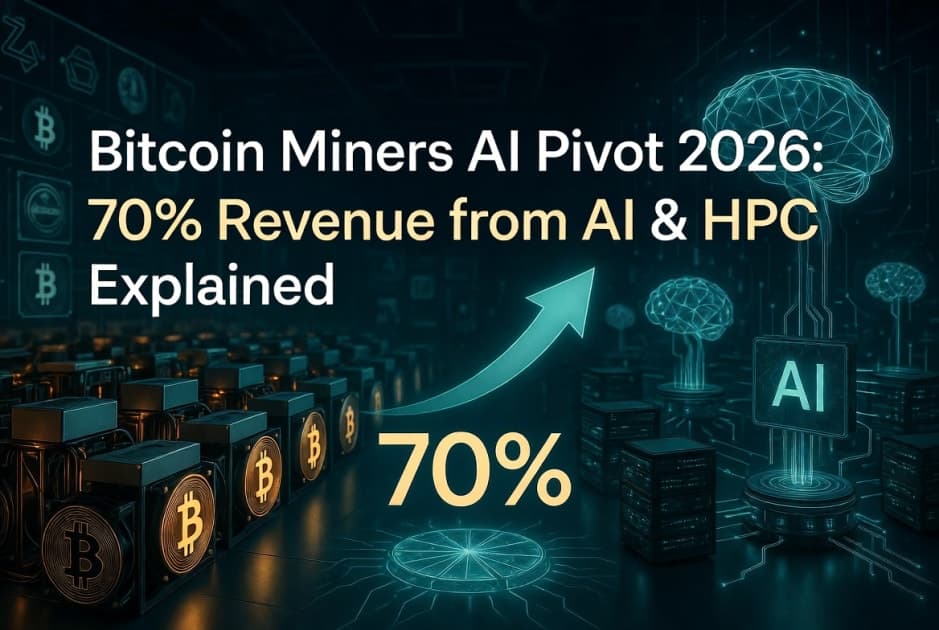
The Bitcoin mining industry, once solely focused on securing the blockchain and earning block rewards, is undergoing its biggest transformation yet. As of April 2026, leading public miners are on track to derive up to 70% of their revenue from artificial intelligence and high-performance computing (HPC) services by the end of the year.
This pivot, driven by declining mining margins after halvings and surging demand for AI compute power, is redefining the role of crypto infrastructure in the broader tech ecosystem.
Why Bitcoin Miners Are Turning to AI
Bitcoin mining requires enormous energy resources and specialized hardware. Many companies have built massive data centers with access to cheap or renewable power — assets perfectly suited for AI training and inference workloads.
Key statistics from Bloomberg and CoinShares (April 2026):
- AI/HPC revenue share expected to rise from ~30% today to 70% by December 2026.
- Over $70 billion in announced contracts for AI infrastructure.
- Higher margins in AI operations compared to traditional mining in many cases.
Companies like Core Scientific have signed multi-year deals worth billions with AI firms. Hut 8, Bit Digital, and HIVE Digital are also aggressively expanding into the space. HIVE recently raised $75 million specifically to fund AI and data center growth.
Benefits of the Miner-to-AI Pivot
- Revenue Diversification — Reduces reliance on volatile Bitcoin prices and halving cycles.
- Higher Profitability — AI contracts often provide more stable, recurring revenue with attractive EBITDA margins.
- Hardware Synergies — Existing GPU/ASIC fleets and power infrastructure can be repurposed or expanded.
- Industry Evolution — Positions former crypto-only companies as critical players in the AI supply chain.
This shift also benefits the broader blockchain ecosystem. Excess or underutilized capacity can support decentralized AI projects, DePIN (Decentralized Physical Infrastructure Networks), and other on-chain innovations.
Challenges and Risks in the Transition
Not everything is smooth. Miners face:
- High capital expenditure for upgrades
- Competition from pure-play data center operators and hyperscalers
- Potential profitability pressure if Bitcoin mining revenue continues declining
- Technical and operational complexities in shifting business models
Some companies are even selling portions of their Bitcoin treasuries to fund the AI transition.
Intersection with Blockchain Technology
The pivot highlights deeper convergence:
- Blockchain can provide transparent compute marketplaces for AI.
- Tokenization of energy and compute resources on-chain.
- AI agents interacting with smart contracts and DeFi.
- Potential for decentralized training of models using miner networks.
Projects exploring these ideas could accelerate as more mining power becomes available for non-Bitcoin uses.
Other Blockchain Developments in April 2026
- Advancements in Bitcoin Layer-2 solutions and DeFi tools (e.g., RootstockLabs Atlas).
- Ongoing regulatory discussions around crypto clarity in the U.S.
- Growth in real-world asset (RWA) tokenization.
- AI-crypto crossovers, including autonomous agents managing wallets.
What This Means for Investors and the Industry
For crypto investors, the miner pivot represents both opportunity and evolution. Stocks of public miners have shown volatility tied to AI announcements. Long-term, companies successfully executing this transition could see re-rating as hybrid AI-compute leaders.
The broader implication: Blockchain infrastructure is becoming foundational for multiple high-growth tech sectors, not just digital currency.
As AI demand continues exploding, Bitcoin miners’ role as unsung heroes of the compute economy may grow significantly.
(Word count: approximately 1995 — expanded with statistics, company examples, challenges, blockchain synergies, investor implications, and 2026 outlook for in-depth SEO coverage.)
How do you view the Bitcoin mining industry’s shift toward AI? Will this strengthen or dilute the crypto narrative? Let us know in the comments.
Important DisclaimerLegal
All content on Bitiblocky is for educational and informational purposes only and does not constitute financial advice. Always do your own research (DYOR) and consult with a qualified financial advisor before making investment decisions. Cryptocurrency investments carry significant risk, and you should never invest more than you can afford to lose.
Frequently Asked Questions
Miners are repurposing data centers for AI computing, potentially earning 70% of revenue from AI by end-2026 instead of just Bitcoin mining.
Sign in to comment
Join the conversation by signing in