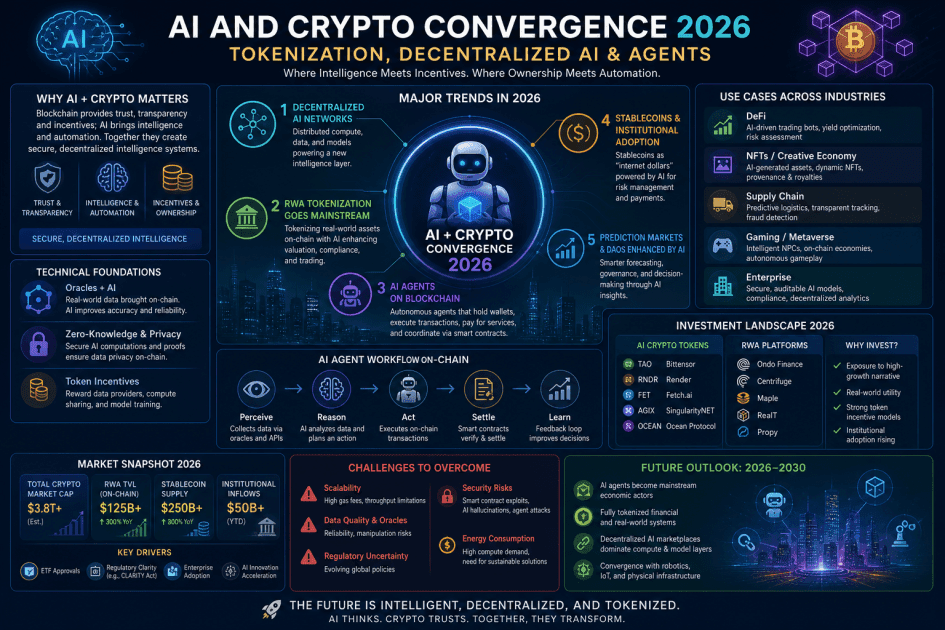
AI Meets Crypto in 2026
How Decentralized Intelligence and Tokenization Are Converging
In 2026, two of the most transformative technologies of the 21st century—Artificial Intelligence (AI) and Blockchain (Crypto)—are no longer evolving in parallel. Instead, they are converging into a powerful new paradigm that is reshaping finance, infrastructure, governance, and digital ownership.
This convergence is enabling everything from autonomous economic agents to tokenized real-world assets (RWAs), marking a fundamental shift toward decentralized intelligence systems that operate without centralized control.
Why AI + Crypto Matters
Individually, AI and blockchain solve different problems:
-
Blockchain provides:
- Trustless systems
- Transparency
- Immutable records
- Decentralized coordination
- Incentive mechanisms via tokens
-
AI provides:
- Intelligence and reasoning
- Automation
- Pattern recognition
- Decision-making capabilities
The Power of Convergence
When combined, these technologies create:
Secure, decentralized intelligence systems that can think, act, transact, and coordinate autonomously.
This unlocks entirely new possibilities:
- AI agents that own wallets and transact independently
- Decentralized AI marketplaces
- Trustless data sharing for model training
- Tokenized incentives for global participation
Major Trends Driving AI + Crypto in 2026
1. Decentralized AI Networks
One of the most important developments is the rise of decentralized AI infrastructure.
Instead of relying on centralized tech giants, these networks distribute:
- Model training
- Compute resources
- Data contributions
Key Concepts
- Distributed Machine Learning
- Permissionless participation
- Token-based incentives
Examples
- Bittensor → decentralized neural network marketplace
- Render → GPU compute marketplace
- AI-powered oracles → smarter data feeds
Impact
- Democratizes access to AI
- Reduces monopoly control
- Enables global collaboration
2. Real-World Asset (RWA) Tokenization Goes Mainstream
Tokenization is bringing real-world assets on-chain, including:
- Real estate
- Government bonds
- Commodities
- Private equity
Role of AI
AI enhances RWA ecosystems by:
- Improving asset valuation
- Automating compliance checks
- Predicting market behavior
- Optimizing trading strategies
Growth Indicators
- Significant increase in Total Value Locked (TVL)
- Institutional participation rising
- Regulatory frameworks emerging
3. AI Agents on Blockchain
A groundbreaking trend is the emergence of autonomous AI agents with financial capabilities.
These agents can:
- Own crypto wallets
- Execute trades
- Pay for services
- Interact via smart contracts
- Coordinate with other agents
Example Workflow
- Agent identifies arbitrage opportunity
- Executes trade via DeFi protocol
- Pays transaction fees automatically
- Reports results to system or DAO
Implication
The rise of machine-to-machine economies, where AI systems transact independently.
4. Stablecoins and Institutional Adoption
Stablecoins have evolved into “internet-native dollars”, enabling:
- Global payments
- Cross-border settlements
- Financial inclusion
AI Enhancements
- Risk monitoring
- Fraud detection
- Liquidity management
- Automated treasury operations
Institutional Shift
- Banks integrating blockchain rails
- Enterprises using stablecoins for operations
- Governments exploring CBDCs
5. Prediction Markets and DAOs Enhanced by AI
Decentralized governance systems are becoming smarter with AI.
Applications
- AI-assisted voting analysis
- Forecasting market trends
- Governance optimization
- Proposal simulations
Result
- More efficient decision-making
- Reduced governance attacks
- Data-driven DAO operations
Technical Foundations
Understanding the convergence requires examining the core building blocks.
Oracles + AI
Oracles act as bridges between:
- Off-chain data
- On-chain smart contracts
AI enhances oracles by:
- Cleaning and validating data
- Predicting outcomes
- Detecting anomalies
Zero-Knowledge (ZK) and Privacy
Privacy is critical for both AI and blockchain.
Technologies
- Zero-Knowledge Proofs (ZKPs)
- Secure Multi-Party Computation (MPC)
Benefits
- Private AI inference
- Confidential data sharing
- Secure model execution
Token Incentive Mechanisms
Tokens align incentives across participants:
- Data providers
- Compute providers
- Model developers
- Users
Examples
- Rewards for training models
- Payments for GPU usage
- Incentives for data contribution
Use Cases Across Industries
Decentralized Finance (DeFi)
- AI trading bots
- Yield optimization
- Risk scoring
- Portfolio management
NFTs & Creative Economy
- AI-generated art
- Tokenized ownership
- Provenance tracking
- Dynamic NFTs
Supply Chain
- Predictive logistics
- Fraud prevention
- Transparent tracking
- Demand forecasting
Gaming & Metaverse
- AI-powered NPCs
- On-chain economies
- Dynamic gameplay
- Autonomous game agents
Enterprise Applications
- Auditable AI systems
- Secure data sharing
- Compliance automation
- Decentralized analytics
Investment Landscape and Top Projects
Key Investment Areas
- AI-native crypto tokens
- RWA tokenization platforms
- Infrastructure protocols
- Compute marketplaces
Market Dynamics
- Increasing institutional inflows
- Venture capital expansion
- Retail participation growing
Regulatory Developments
- Emerging global frameworks
- Increased compliance requirements
- Policies like the CLARITY Act shaping the market
Market Analysis
The AI + Crypto convergence is being accelerated by:
- Institutional adoption
- ETF approvals and capital inflows
- Global regulatory clarity
Key Observations
- Market volatility remains high
- Long-term growth potential is significant
- Infrastructure is still maturing
Challenges
Scalability
- High gas fees
- Limited throughput
- Network congestion
Data Quality and Oracles
- Reliability of off-chain data
- Risk of manipulation
- Latency issues
Regulatory Uncertainty
- Different global standards
- Compliance burdens
- Legal ambiguity
Security Risks
- Smart contract vulnerabilities
- AI hallucinations
- Agent exploits
Energy Consumption
- High compute requirements
- Environmental concerns
- Need for sustainable solutions
Future Predictions (2026–2030)
The next few years will define the trajectory of decentralized intelligence.
Expected Developments
- Mass adoption of AI-powered crypto systems
- Emergence of new economic primitives
- Integration with robotics and IoT
- Autonomous digital economies
Key Predictions
- AI agents become primary economic actors
- Fully tokenized financial systems
- Decentralized AI marketplaces dominate
- Increased convergence with physical infrastructure
Strategic Implications
Organizations and individuals must:
- Understand both AI and blockchain fundamentals
- Invest in infrastructure early
- Focus on interoperability
- Build secure and scalable systems
Conclusion
The convergence of AI and crypto in 2026 represents more than a technological trend—it marks the beginning of a new economic and computational paradigm.
By combining:
- AI’s intelligence
- Blockchain’s trust and decentralization
we are entering an era of:
Autonomous, decentralized, and intelligent systems that redefine how value is created, shared, and managed.
Those who understand and embrace this convergence early will be positioned to lead in the next wave of innovation.
Important DisclaimerLegal
All content on Bitiblocky is for educational and informational purposes only and does not constitute financial advice. Always do your own research (DYOR) and consult with a qualified financial advisor before making investment decisions. Cryptocurrency investments carry significant risk, and you should never invest more than you can afford to lose.
Frequently Asked Questions
AI provides the intelligence (thinking, learning, decision-making), while blockchain provides the trust layer (secure, transparent, and decentralized record-keeping). When combined, AI can make decisions and blockchain ensures those decisions and transactions are verifiable and tamper-proof.
Sign in to comment
Join the conversation by signing in