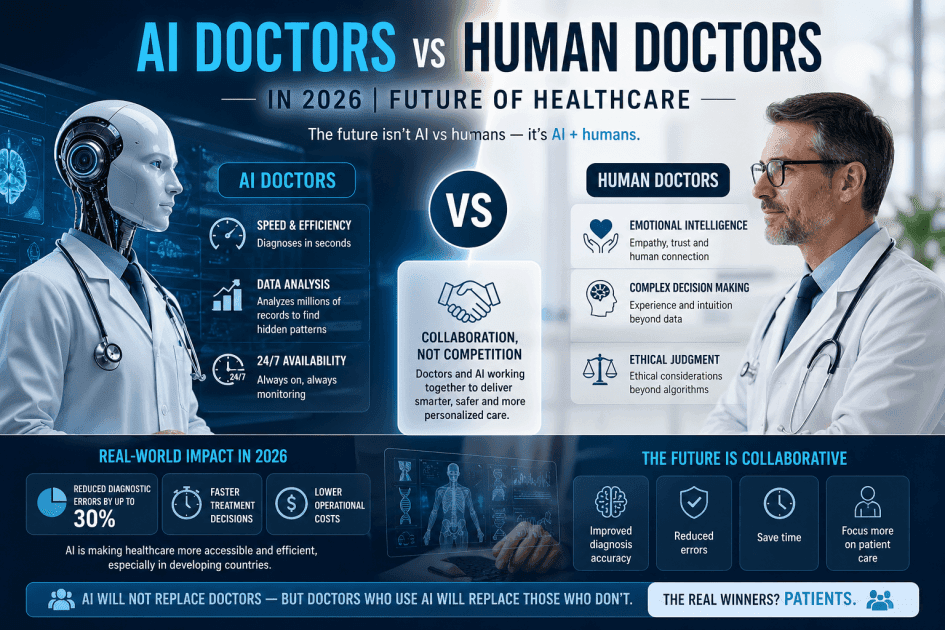
AI Doctors vs Human Doctors: Who Will Lead Healthcare in 2026?
Healthcare is undergoing one of the most significant transformations in human history. In 2026, the rapid advancement of artificial intelligence (AI) is reshaping how medical professionals diagnose diseases, treat patients, and manage healthcare systems.
From smart diagnostic tools to predictive analytics, AI is no longer a futuristic idea — it is actively being used in hospitals, clinics, and research centers around the world.
But this raises a critical question:
Will AI replace human doctors, or will they work together to define the future of healthcare?
The answer is more nuanced than a simple yes or no. To truly understand the future, we must explore how AI and human doctors compare, where each excels, and how they can collaborate to improve patient outcomes.
The Rise of AI in Healthcare
Artificial intelligence has rapidly evolved over the past decade, and by 2026, it has become a core component of modern healthcare systems.
AI technologies are now capable of:
- Diagnosing diseases faster than traditional methods
- Analyzing medical images with remarkable accuracy
- Predicting patient outcomes using historical data
- Automating repetitive administrative tasks
One of the biggest advantages of AI is its ability to process vast amounts of data. While a human doctor may take hours to analyze patient records, AI systems can review millions of data points in seconds.
This speed and efficiency are transforming how healthcare is delivered.
How AI is Changing Medical Diagnosis
Diagnosis is one of the most critical aspects of healthcare, and AI is making significant improvements in this area.
AI-powered tools can:
- Detect early signs of diseases like cancer
- Identify abnormalities in X-rays, MRIs, and CT scans
- Provide decision support for doctors
For example, AI algorithms trained on thousands of medical images can identify patterns that are often invisible to the human eye.
This leads to:
- Faster detection
- Earlier treatment
- Better survival rates
In many cases, AI is not replacing doctors but enhancing their capabilities.
Where AI Outperforms Humans
While human doctors bring experience and judgment, AI has clear advantages in several key areas.
1. Speed & Efficiency
AI systems can analyze complex medical data within seconds.
Tasks that would take hours or days for humans can be completed almost instantly. This is especially useful in emergency situations where time is critical.
2. Data Analysis
Healthcare generates massive amounts of data every day.
AI can:
- Analyze patient histories
- Compare global datasets
- Identify trends and patterns
This allows for more accurate diagnoses and personalized treatment plans.
3. 24/7 Availability
Unlike humans, AI systems never need rest.
They can monitor patients continuously, providing:
- Real-time alerts
- Ongoing health tracking
- Immediate responses in critical situations
This is particularly valuable in intensive care units and remote healthcare settings.
4. Consistency and Reduced Errors
Human errors can occur due to fatigue, stress, or oversight.
AI systems, when properly trained, provide:
- Consistent performance
- Reduced diagnostic errors
- Standardized decision-making
Where Human Doctors Still Win
Despite the impressive capabilities of AI, human doctors remain essential in healthcare.
1. Emotional Intelligence
Healthcare is not just about data — it’s about people.
Patients need:
- Empathy
- Compassion
- Reassurance
Human doctors can understand emotions, build trust, and provide comfort in ways AI cannot.
2. Complex Decision Making
Not all medical cases are straightforward.
Many situations involve:
- Multiple conditions
- Unclear symptoms
- Unique patient histories
Human doctors use experience, intuition, and critical thinking to make complex decisions that AI may struggle with.
3. Ethical Judgment
Healthcare decisions often involve ethical considerations.
For example:
- End-of-life care
- Risk vs benefit analysis
- Patient consent
AI lacks moral reasoning, while human doctors can make decisions based on ethical principles.
4. Adaptability and Creativity
Human doctors can adapt to new situations, think creatively, and make decisions in uncertain environments.
AI, on the other hand, relies on existing data and predefined models.
AI vs Human Doctors: A Balanced Perspective
Rather than viewing AI and human doctors as competitors, it is more accurate to see them as partners.
AI excels in:
- Data processing
- Speed
- Accuracy
Humans excel in:
- Empathy
- Judgment
- Ethical reasoning
Together, they create a powerful combination.
The Future: Collaboration, Not Competition
The future of healthcare is not AI replacing doctors — it is AI empowering doctors.
In 2026 and beyond, doctors will increasingly rely on AI as a tool to enhance their work.
Doctors will use AI to:
- Improve diagnostic accuracy
- Reduce medical errors
- Save time on administrative tasks
- Focus more on patient care
This collaboration allows doctors to spend more time interacting with patients rather than dealing with paperwork or data analysis.
Real-World Impact in 2026
AI is already making a measurable impact in healthcare systems worldwide.
Hospitals using AI technologies are experiencing:
- Reduced diagnostic errors by up to 30%
- Faster treatment decisions
- Improved patient outcomes
- Lower operational costs
AI is also helping to address one of the biggest challenges in healthcare: accessibility.
AI in Developing Countries
In developing regions, access to healthcare is often limited due to:
- Shortage of doctors
- Lack of infrastructure
- High costs
AI is helping bridge this gap by:
- Providing remote diagnosis
- Enabling telemedicine services
- Offering low-cost healthcare solutions
This is particularly important in countries where healthcare resources are stretched thin.
AI in Hospital Management
Beyond diagnosis and treatment, AI is also transforming hospital operations.
It is being used for:
- Patient scheduling
- Resource allocation
- Predictive maintenance
- Workflow optimization
This improves efficiency and reduces the burden on healthcare staff.
Challenges and Concerns
Despite its benefits, AI in healthcare also raises concerns.
1. Data Privacy
Healthcare data is highly sensitive.
There are concerns about:
- Data breaches
- Unauthorized access
- Misuse of information
2. Dependence on Technology
Over-reliance on AI could reduce human oversight.
Doctors must ensure that AI remains a tool, not a replacement for critical thinking.
3. Bias in AI Models
AI systems are only as good as the data they are trained on.
Biased data can lead to:
- Incorrect diagnoses
- Inequality in treatment
4. Regulatory Challenges
Governments and organizations are still developing regulations for AI in healthcare.
Ensuring safety, accuracy, and accountability is essential.
Future Outlook
Looking ahead, the role of AI in healthcare will continue to grow.
By 2030, we can expect:
- More advanced AI diagnostic tools
- Fully integrated smart hospitals
- Personalized medicine powered by AI
- Improved global healthcare access
However, human doctors will remain at the center of healthcare systems.
Final Thoughts
AI is transforming healthcare in ways we could not have imagined just a decade ago.
But it is not here to replace doctors.
Instead, it is here to enhance their abilities, reduce their workload, and improve patient outcomes.
The real shift is not about AI vs humans — it is about AI working with humans.
Conclusion
AI will not replace doctors — but doctors who use AI will replace those who don’t.
The healthcare industry is entering a new era where technology and human expertise work hand in hand.
The ultimate beneficiaries of this transformation are not machines or professionals.
They are the patients.
Important DisclaimerLegal
All content on Bitiblocky is for educational and informational purposes only and does not constitute financial advice. Always do your own research (DYOR) and consult with a qualified financial advisor before making investment decisions. Cryptocurrency investments carry significant risk, and you should never invest more than you can afford to lose.
Frequently Asked Questions
No, AI cannot replace human empathy and complex decision-making.
Sign in to comment
Join the conversation by signing in