Agentic AI in 2026 🤖
The Rise of Autonomous Intelligence and Its Industry Impact
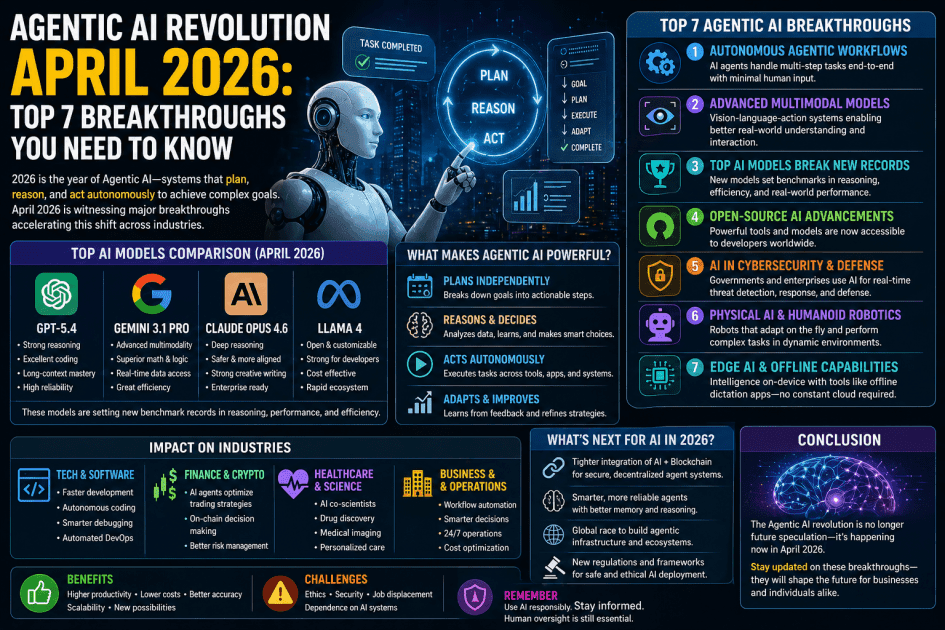
The year 2026 is rapidly shaping up to be a defining moment in the evolution of artificial intelligence. While previous waves of AI focused heavily on content generation—text, images, and code—the current transformation is far more profound. We are now entering the era of Agentic AI: systems that do not merely respond to prompts but can plan, reason, make decisions, and act autonomously to accomplish complex, multi-step goals.
In April 2026, this shift is accelerating at an unprecedented pace. From advanced multimodal models to autonomous workflows and real-world robotics, Agentic AI is redefining how humans interact with machines—and how machines operate independently.
This comprehensive guide explores the top breakthroughs, technologies, models, and industry impacts driving the Agentic AI revolution today.
What is Agentic AI?
Agentic AI refers to artificial intelligence systems designed to function as autonomous agents. Unlike traditional AI tools that require constant human input, these systems can:
- Understand high-level objectives
- Break them down into actionable steps
- Execute tasks independently
- Adapt to new information in real-time
- Learn from feedback and improve performance
In simple terms, Agentic AI acts more like a digital employee or collaborator than a passive tool.
Why 2026 is a Turning Point
Several factors have converged to make 2026 the breakthrough year for Agentic AI:
- Massive improvements in model reasoning capabilities
- Integration of multimodal inputs (text, image, audio, video, actions)
- Increased availability of compute power and infrastructure
- Strong investment from governments and private companies
- Rapid growth of open-source AI ecosystems
As a result, AI is moving beyond assisting humans—it is now actively executing tasks on behalf of humans.
Top 7 Agentic AI Breakthroughs (April 2026)
1. Autonomous Agentic Workflows 🔄
One of the most significant breakthroughs is the rise of autonomous workflows powered by AI agents.
These systems can handle multi-step tasks such as:
- Managing business operations
- Automating customer support
- Conducting research and generating reports
- Executing software development tasks
Instead of requiring step-by-step instructions, these agents can plan entire workflows independently, making them extremely powerful for businesses.
Why it matters:
- Reduces human workload
- Improves efficiency and scalability
- Enables 24/7 operations
2. Advanced Multimodal Models 👁️🗨️
Modern AI systems are no longer limited to text. The latest models integrate:
- Vision (images and video)
- Language (text and speech)
- Actions (real-world interactions)
These vision-language-action models enable AI to interact with the world in a more human-like way.
Examples of capabilities:
- Analyzing images and taking actions based on them
- Controlling devices through visual input
- Understanding real-world environments
This is a major step toward general-purpose AI systems.
3. Top AI Models Comparison 🏆
Several cutting-edge AI models are leading the Agentic AI revolution in 2026:
- GPT-5.4
- Gemini 3.1 Pro
- Claude Opus 4.6
- Llama 4
These models are pushing the boundaries of:
- Logical reasoning
- Task execution
- Efficiency and speed
- Context understanding
Key advancements:
- Improved long-context memory
- Better decision-making capabilities
- Enhanced reliability and safety
They are setting new benchmark records across multiple AI evaluation metrics.
4. Open-Source AI Advancements 🌍
Open-source AI is playing a critical role in democratizing access to powerful tools.
Developers worldwide can now:
- Build custom AI agents
- Modify and improve existing models
- Deploy AI systems without relying on big tech companies
Benefits:
- Faster innovation
- Greater transparency
- Reduced costs
This movement is accelerating the global adoption of Agentic AI.
5. AI in Cybersecurity and Defense 🛡️
Governments and organizations are increasingly integrating AI into security and defense systems.
Agentic AI is being used for:
- Real-time threat detection
- Automated response systems
- Predictive risk analysis
Why it’s critical:
- Cyber threats are becoming more sophisticated
- Manual monitoring is no longer sufficient
- AI provides speed and accuracy
This is one of the most impactful and sensitive applications of Agentic AI.
6. Physical AI & Humanoid Robotics 🤖
The integration of AI into physical systems is creating a new class of intelligent machines.
Humanoid robots are now capable of:
- Adapting to dynamic environments
- Learning from real-world interactions
- Performing complex physical tasks
Key developments:
- Improved motor control
- Real-time decision-making
- Better environmental awareness
This brings us closer to a future where robots can assist in everyday human activities.
7. Edge AI and Offline Capabilities 📱
Another major breakthrough is the rise of Edge AI, where intelligence is embedded directly into devices.
Examples include:
- Offline voice assistants
- On-device AI processing
- Tools like Google’s offline dictation apps
Advantages:
- Reduced dependency on cloud infrastructure
- Faster response times
- Improved privacy
Edge AI ensures that powerful AI capabilities are accessible anytime, anywhere.
Impact of Agentic AI on Industries
Tech & Software Development
Agentic AI is revolutionizing software development by enabling:
- Autonomous coding assistants
- Faster debugging and testing
- Automated deployment pipelines
Developers can now focus on high-level design, while AI handles repetitive tasks.
Finance & Cryptocurrency
AI agents are transforming financial markets by:
- Optimizing trading strategies
- Managing portfolios automatically
- Executing on-chain decisions in crypto ecosystems
This leads to faster and more data-driven decision-making.
Healthcare & Scientific Research
Agentic AI is acting as a co-scientist, accelerating discoveries in:
- Drug development
- Disease diagnosis
- Medical research
Benefits:
- Faster breakthroughs
- Reduced research costs
- Improved patient outcomes
This could lead to life-saving innovations in the near future.
Business & Operations
Companies are using Agentic AI to:
- Automate workflows
- Improve customer service
- Enhance decision-making
This results in:
- Increased productivity
- Lower operational costs
- Competitive advantages
What’s Next for AI in 2026?
Looking ahead, several trends are expected to shape the future of Agentic AI:
AI + Blockchain Integration
The combination of AI and blockchain will enable:
- Secure and decentralized AI agents
- Transparent decision-making systems
- Trustless automation
This could redefine how digital systems operate.
Smarter and More Reliable Agents
Future AI systems will become:
- More accurate
- More trustworthy
- Better at handling complex tasks
Reliability will be a key focus area.
Global AI Infrastructure Race
Companies and governments are competing to build:
- Scalable AI platforms
- Robust infrastructure
- Advanced agent ecosystems
The winners of this race will likely lead the next technological revolution.
Challenges and Risks
Despite its potential, Agentic AI also presents challenges:
- Ethical concerns around autonomy
- Security risks
- Job displacement
- Dependence on AI systems
Proper regulation and responsible development will be crucial.
Conclusion
The Agentic AI revolution is no longer a concept of the future—it is actively unfolding in April 2026.
With breakthroughs in:
- Autonomous workflows
- Multimodal intelligence
- Robotics and Edge AI
we are witnessing a fundamental shift in how technology operates.
Agentic AI is transforming industries, redefining productivity, and opening new possibilities for innovation. However, with great power comes responsibility. Businesses, developers, and individuals must stay informed and adapt to this rapidly evolving landscape.
The coming years will likely determine how successfully humanity can harness the full potential of autonomous intelligence.
Stay ahead of the curve—because the future of AI is not just intelligent, it’s agentic.
Important DisclaimerLegal
All content on Bitiblocky is for educational and informational purposes only and does not constitute financial advice. Always do your own research (DYOR) and consult with a qualified financial advisor before making investment decisions. Cryptocurrency investments carry significant risk, and you should never invest more than you can afford to lose.
Frequently Asked Questions
Agentic AI goes beyond simple input-output tasks. Unlike traditional AI, which requires constant human prompts, Agentic AI systems can independently plan, make decisions, and execute multi-step tasks to achieve a goal. This makes them more like autonomous digital assistants or workers rather than passive tools.
Sign in to comment
Join the conversation by signing in